Starting last year, I made a personal pledge to see any movies that interest me in the theaters. I have historically never been really into movies, but I have gotten to the point in life where that has changed. So, whenever I see a movie, I keep an eye out on the trailers as well to see if something interesting pops up. Scarlet was one of those films.
An original animated film directed by Mamoru Hosoda – whom of which directed Summer Wars, a weird but fun to watch anime film I enjoyed as a younger fella. The trailers for this move were well made: it had presented a growing war of two sides of a long-past era, and a modern day man who somehow gets pulled into it. I was convinced to pick up a ticket last night before it left the theaters.
As I prefer to do reviews with a “from the top,” I will begin by saying I still have mixed feelings on this movie, but I am hovering at that 4.5-5 / 10 range. Now, let’s dive into why it’s hovering on the worse half of a “mid” film:
The establishment of the film’s story is a gender-bent revision on Shakespeare’s Hamlet. Scarlet – the princess of Denmark in the 1600s – loves her father dearly. We are treated to seeing how his benevolence and attitude toward peace permeate and guide young Scarlet’s heart. Much like Hamlet though, Claudius (the uncle), has a thirst for power, and true to the tale, this leads to a set up in which the king is executed for being a traitor. During this scene, he shouts something to Scarlet but she cannot quite hear it – this is important to hang on to.
Time moves forward, and the attempt on Claudius’ life is done, but the tables turn and Scarlet ends up “dying” in her attempt to poison her uncle. This whole opening is done quite fast and for good reason. It is a contextual establishment to the story and Scarlet’s motivations, and this isn’t a Hamlet movie, it simply uses the work creatively. However, while this pacing works here, it continues to be applied in the rest of the direction of the film. And this is my biggest and first qualm with Scarlet. Pacing is the enemy that destroys this film. When things should be longer, given more focus, more dram and tension, it is sped up and when moments don’t really contribute overall, they are given too much time.
The Pacing Problem
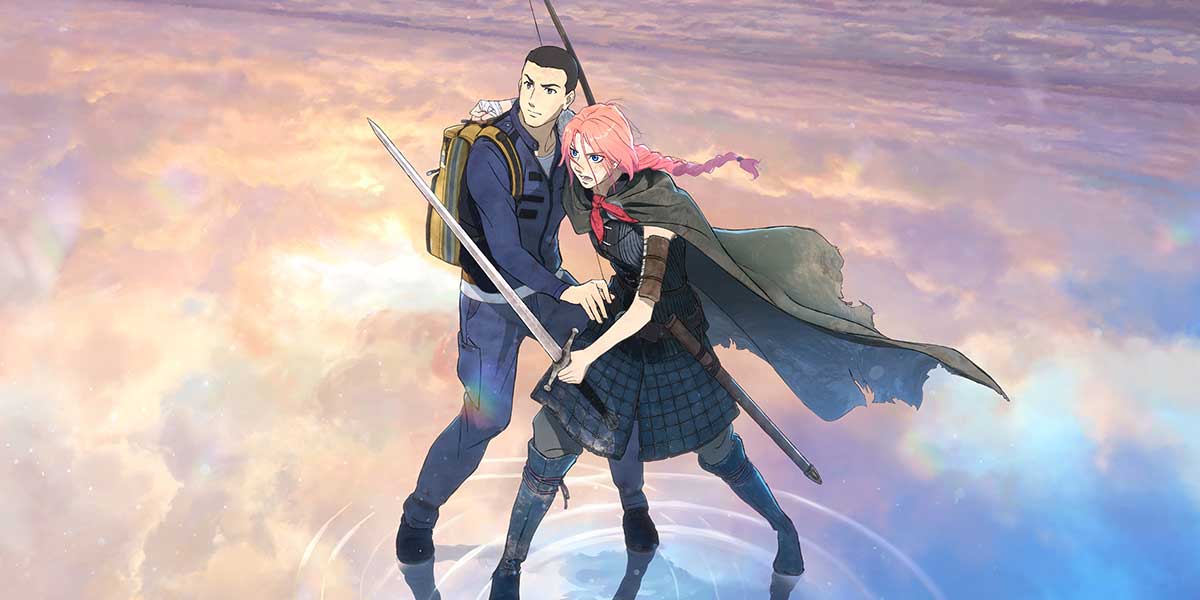
To provide more context, the movie truly starts in the “Otherworld,” noted as a place where life and death coexist. Scarlet awakes here and does not immediately turn to nothingness as she is fueled by her need for revenge. The movie does a montage of her scavenging old weapons, shaping them up and getting in a few fights. The pacing works in these moments because we have already seen her train with the sword – now we just need to know how she got her equipment. But then, later in the movie, what should be the build up or the rising climax is quick-cut straight to the peak, dropping any additional character or world building.
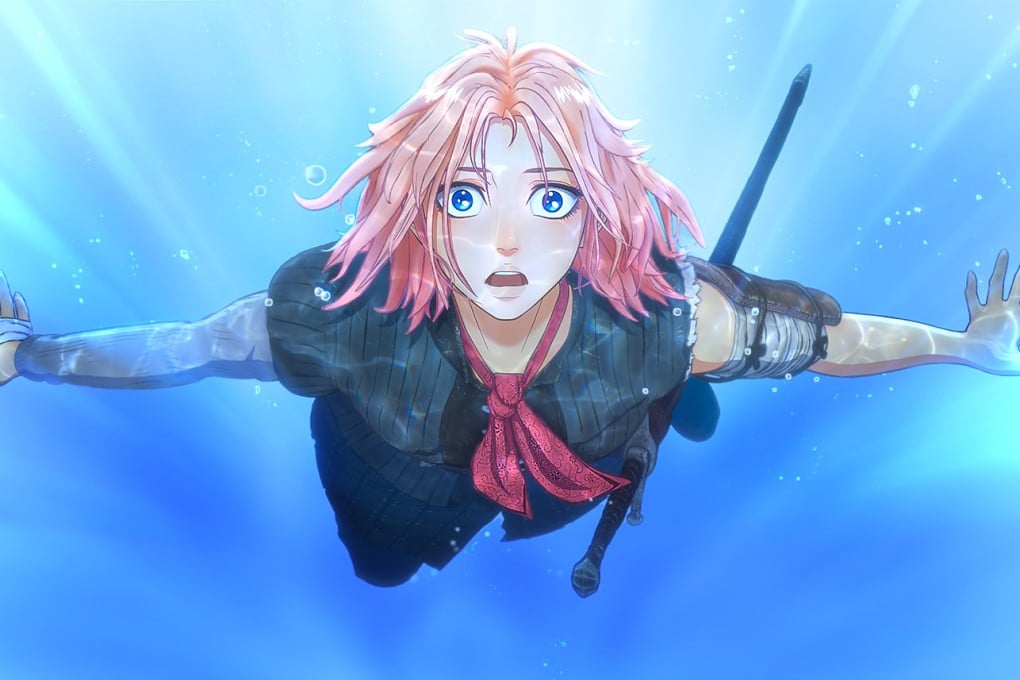
My friend who had seen it with me agreed that he felt this movie was flip-flopping all over the place, and the pacing is the culprit for this feeling. While I was watching, I kept waiting (or hoping)for some longer scenes that had more depth and development, because every scene had the wrong pacing even 1 hour into the film. I was ultimately let down. We get important scenes of fights or drama that last at times no longer than a few minutes, while we get other scenes of peace that try to push the metaphorical narrative that get entire TRANSITIONS that last several minutes alone. I am confused about the pacing in this movie as it is directed by a long-established and award winning director.
The Character Problem
Scarlet is the protagonist, but we have a companion of the name Hijiri as a secondary main character. Hijiri is obviously used to serve as the “guiding light” to Scarlet in her time of being blinded by vengeance. A EMT from the modern day, Hijiri early on shows disdain towards taking a life and only wants to talk things out and heal people who have been hurt.
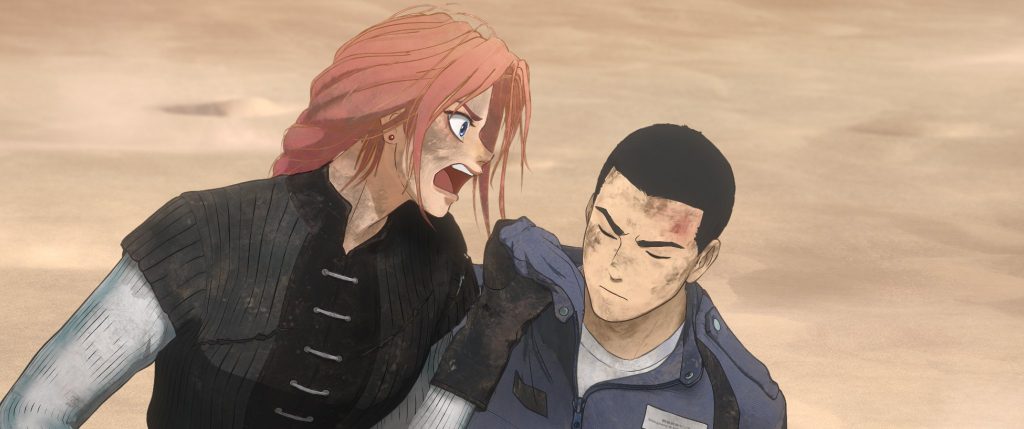
The trailers for this movie made Hijiri appear as a major boon to this film’s plot, and they definitely tried to write him as that, but it seems along the way – either due to editing or production decisions – decided to give up finishing his characterization. Hijiri is for the most part dragged around to heal people and say that death is bad. When we are introduced, he doesn’t even have any establishing context like Scarlet.
Quick tangent: this film opened Scarlet’s story with “Her Arrival” in a sort of chapter-title establishment. We would expect Hijiri to have his shot as well, but this never happens!
Hijiri is unfortunately surmised to nothing but a romantic interest for Scarlet. He is obviously meant to serve as a narrative device, the character that helps Scarlet see the light, but this is haphazardly handled much like all other writing and direction in this film.
My final peeve about this character: the entire movie makes the audience feel like he should not be here – they do not open up about his death until the very end. There is a character, a witch like lady that lives in the Otherworld we see when Scarlet arrives. At a rising climax battle in which Hijiri decides he needs to fight, this witch appears and is surprised to see him there. “What are you doing here? “she asks him. It makes it appear the movie is trying to say “Hijiri is not the same as the other beings here” and maybe there is something he is based off of that supports this. Maybe I am missing it. But they end his character off by revealing his death in the real world and completely drop this interesting opportunity to use him as something else – a guardian angel, a guide, something!
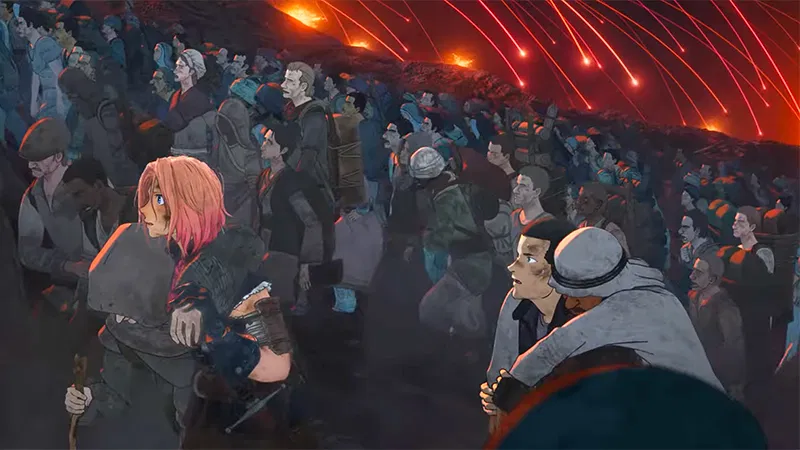
The rest of the characters, primarily the evil ones, are way too cartoonishly evil. They never take advantage in combat, they all act like boisterous fools at all times (ultimately leading to their downfall), it all makes the fight and the stakes feel useless. This film could have foregone the big battle spectacle and been just the same – maybe even better.
The Impact Problem
The overall message that Scarlet tries to convey is that life is precious, forgive yourself and live on. This has been told before and is in all fairness an important reminder, especially in tumultuous times. And there are many metaphors, allegories and story beats to use to creatively express this message. Scarlet pulls it off at times, but the overall connected narrative confuses itself between its lack of characterization and bad pacing that any impact you could have had on the audience is completely lost.
What should have been an empowering and moving ending felt confusing, unfinished and even a little corny. And it all could have been avoided had the previous two problems been fixed in this narrative. The movie’s connecting of the story and its themes and metaphors happen too frequently on this bad pacing that we spend more time getting bits of “think about this sort of metaphorical lesson” where the lesson is somewhat different each time. For example, early on, after they save a caravan being raided by bandits, the same caravan offers to travel with them. Hijiri willingly agrees, Scarlet begrudgingly obliges. This long scene showing them travel and live with these folk culminate in the leader talking to Scarlet, and he spits the lesson out for us: “when you’ve been betrayed enough, you start to long for someone to trust.”
Another lesson that is important to learn, but the movie doesn’t really use it. Betrayal only came in the form of the Hamlet story and then the same cartoonishly evil villains throwing hands with Scarlet. There wasn’t enough there to make this moment feel impactful. And then it ends with a dance scene that is drawn out way too long. The impact did not happen, but the film assumes it did it perfectly and ties it off with a funny dance scene – a scene of peace for our heroes.
The movie uses the same song as a emotional connection and Hijiri sings this song to Scarlet one night when she awakes from a nightmare. Before this, he asks what she would live like if she was in another life. This song puts her in a trance, and for about what felt like 5 to 6 minutes of film runtime was spent on her envisioning herself in the modern era dancing with Hijiri. Scarlet breaks down at this image, seeing she would have been happy in another life. This is a beautifully animated moment, but the impact is not there. I get that this was her moment of change (hence by the fact the following scene shows her cutting her hair short – a trope in many a anime when a woman shows resolve in changing). But, the movie didn’t do enough beforehand to make it seem like Scarlet was truly blinded by revenge. She wavers in her quest and ability for the majority of the film up to this point.
And the worst offender: the ending has no impact outside of its visuals and strong acting. The ending attempts to wrap up all of these half hearted narrative points in one bundle and does so in a rush, leading to one of the most disappointing attempts at tugging on my heart strings I have ever felt.
The Conclusion
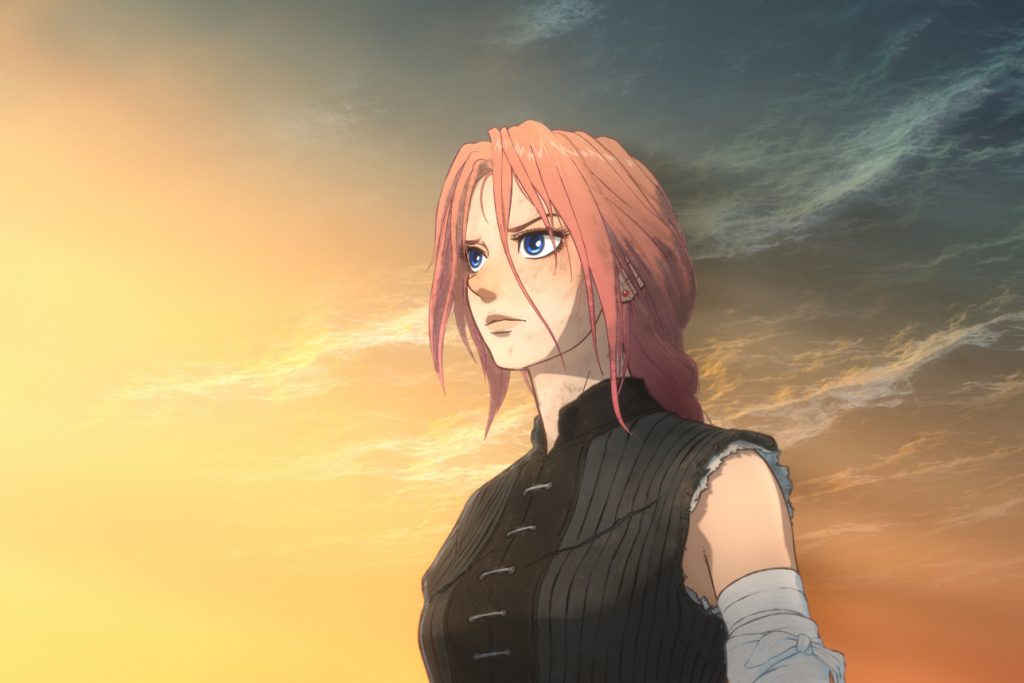
The 2025 animated film Scarlet has a problem crafting a concise narrative. It opens up several branches for characters and different allegories but cuts them off prematurely or never really develops them. What is left a visually and well-acted animated film that makes obvious attempts to have impactful moments and an impactful ending, but its disservice to its own plot points and characters leaves it so there is no impact at any point whatsoever.
This is a rare case where I believe a movie would have benefited from being longer. Had they more time to craft longer scenes to give us more info behind Hijiri, give the two more time to form a relationship, and provide more tensity building to the final battle spectacle, this film would have been stellar. Unfortunately, this is simply a visually appealing but confusing, poorly connected narrative dud.