Hello degens. It has been roughly a month since the last devlog, so it seems I am (sorta) getting back into the once a month updates. The project is going smoothly so far!
Project Pages
First, I have published official pages for Fertile Hearts on Itch.io and Ci-en now! These are both outlets to help spread the word and build some initial interest. I want to work on this game for as long as I can, but we are getting to the stage that, by the time I get a first early-access demo out, I need there to be some metric of demand to make sure it is worth it.
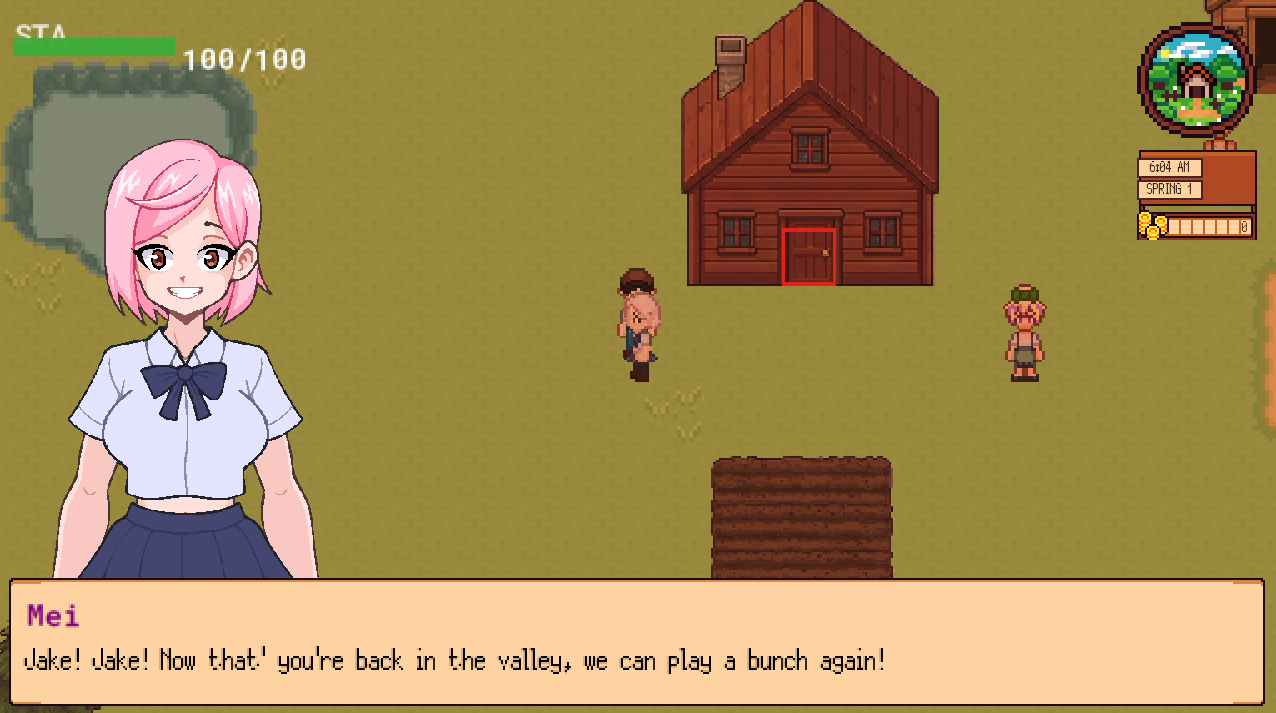
We have done the initial design work for Mei Furukawa – Miyuki and Hiroshi’s cheerful daughter! Her and the player used to be real close friends as kids, so now that you’re back in the valley, it’s your chance to reconnect and nurture your relationship!
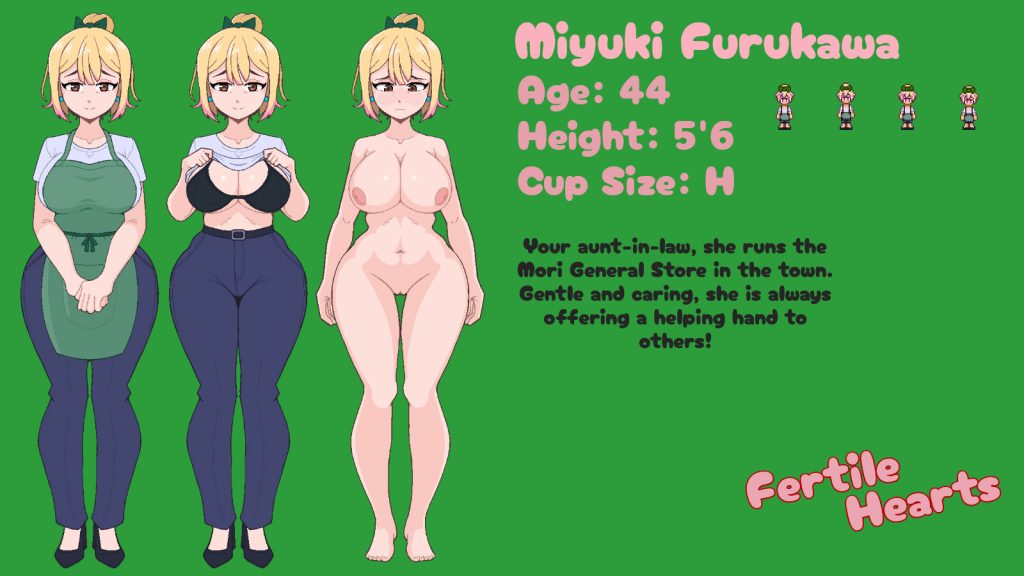
I also got a promo card set up for Miyuki, please take a look!
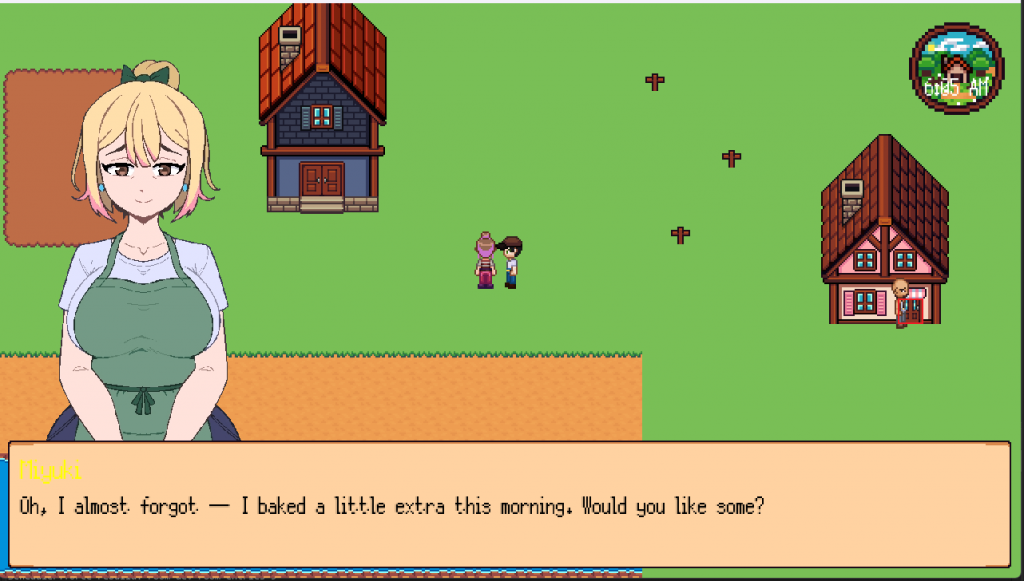
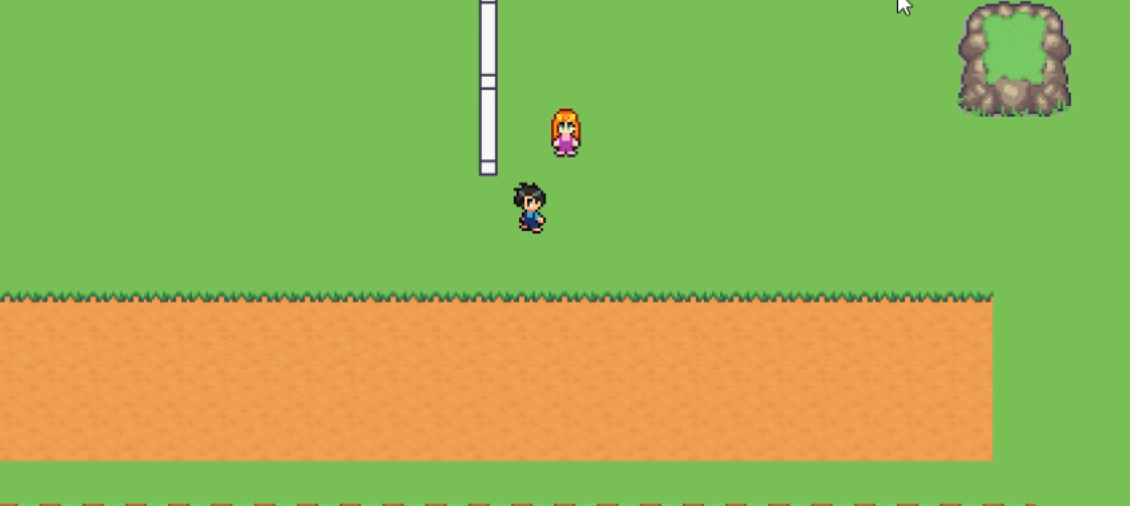
I have Mei’s sprites in the project and some of the early dialogue work is done:
Menus
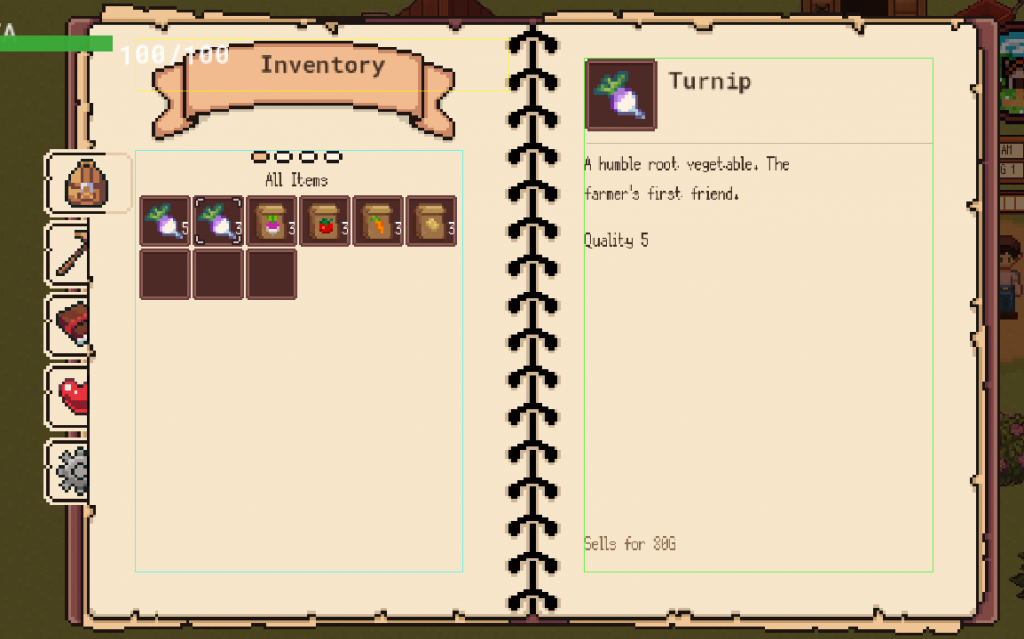
The menu currently available in the tech demo was the first-attempt. I had a lot of the artwork separate to try and control animations individually via code, but it was just not working to get it connected right, and resolution adjustments down the road would break it. So, I have took to Aseprite to piece together some awesome sprite assets into a new, cohesive menu:
The whole book and tabs are now one, frame-animated sprite and in my opinion look much better. It isn’t in the screenshot, but I have implemented a move and trash option for your Inventory too!
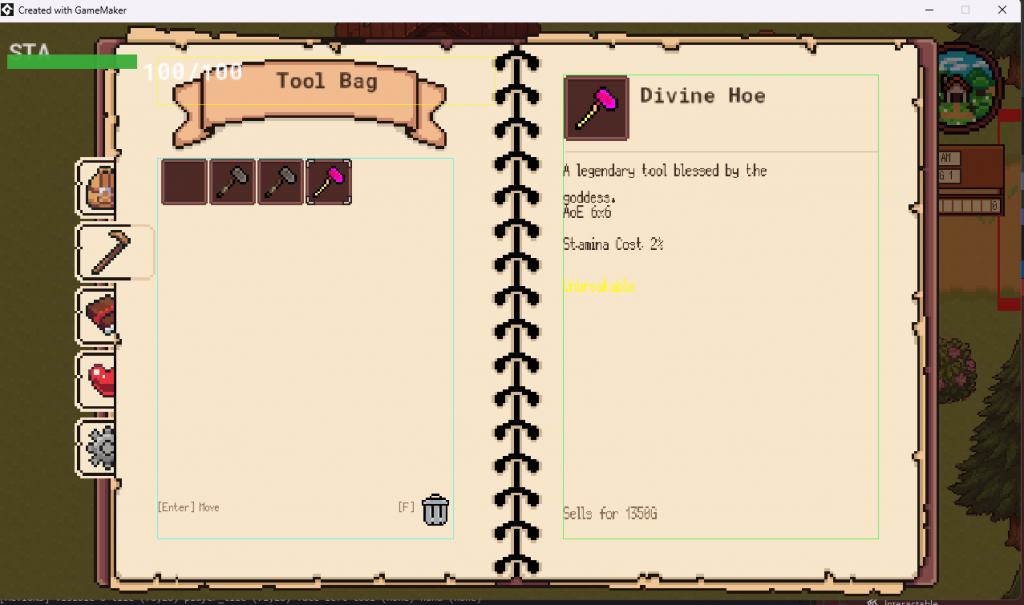
The tools page is here too. Tool inventory is separate, and they do break, so a separate bag just for them should help you stock up on tools!
Other updates thus far:
Emotes on over-world sprites for more immersion
More planning and direction added to Master Design Document
Bug fixes in multiple places
Player Name variable now inserts into dialogue
I have some good stuff cooking up towards the 0.0.1 early-access playable demo. Still need to do the weather system, get art for Hiroshi-san, finish up initial dialogues, and implement the Options system and the big one: Save File system.
I will be cross-posting these blog posts over on itch.io and ci-en, so I would greatly appreciate if you’d follow and interact with the pages and help spread the word about the project!
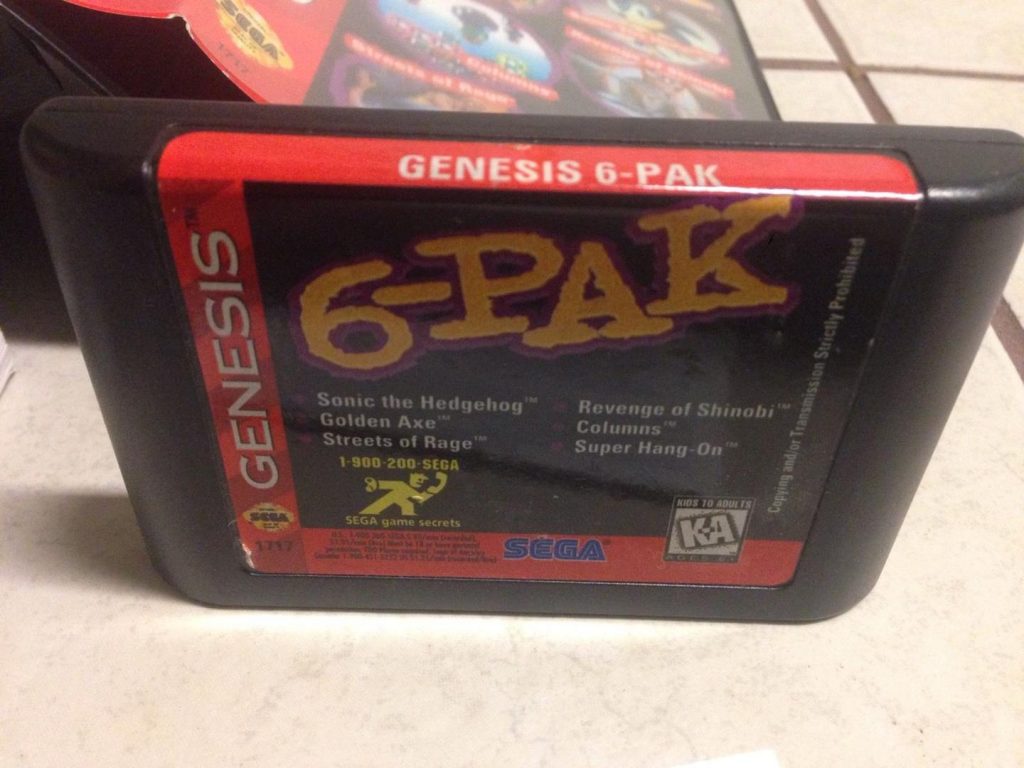
The first game I played on this was Super Hang-On. My tiny toddler brain was not really aware of what was going on, but it knew it was enjoying the images of the man on the motorcycle drifting around.
I ended up playing this cartridge a lot (albeit, not really understanding that games had a goal, it was more of a jingle-keys to). I’d watch my dad play through Streets of Rage, and remember when I realized there was more than the first level that I had become hooked. Basically, it was a bad move on my parent’s part because I became hooked to playing games. I have been playing quite literally my whole life. Even in periods where I was more interested being a social kid and tinkering on websites and software online, I was still taking time to play flash games, Minecraft, whatever I could. It is my biggest vice, but one that I love to have.
When you’re a kid, you almost never take time to think of things like politics, industry trends and economics. You are given many things to entertain yourself with, and for many people video games are one of those – whether you had a console or are a “iPad kid,” you were typically playing a video game at some point. And honestly, with a fully developed frontal-lobe, you can look back and realize the games as a product, as a technical interactive program, were bad. But that’s the interesting thing: your age and worldview skew perspective to wear even the most busted games would be hours of fun to you.
I want to open by noting that nothing lasts forever. Things will always change. But it is important with how (relatively) young the gaming industry is that we state with how the relationship between the player or consumer and the publisher/developer used to be. Funnily enough, we see despite being so young, this cycle is occurring in some similar way now.
The first home console released in 1972 with the Magnavox, but the true starting point was with the 1975 release of Home Pong from Atari. Arcades were all the rage – games were a new product that the youth wanted to experience every pixel of. This grew exponentially thanks in part to Nintendo, then Sega. The industry learned quickly with the game crash of 1983 – in which we see a similar story to today in where a plethora of games released at poor quality, leading to a recession in the industry. I want to forward to my childhood era of games – for me this really kicked up with the PlayStation 2 and Nintendo Gamecube (and Gameboy Advance).
I’ll spare the details of child-like awe (because those rose tinted glasses are a big part of why we feel the games “back then” were better), but there is still some merit in the sentiment we share about the games back in the day. 3D graphics really reinvigorated the industry, and we saw many game enthusiast become developers and publishers. Lots of games had hit in the late-90s to mid 2000’s that, by today’s standards are bare bones, were still oozing with creativity, passion and fun. Halo’s approach to sci-fi shooting in space environments with aliens and a zombie-apocalypse type threat were massive for the FPS genre. Sonic’s early 3D titles, while technically borky, were still filled with creative ideas and fun stories. Resident Evil was released, as well as Silent Hill and others that virtually created the survival horror genre as it is today.
If you were born in the mid to late-90s, you were basically playing the establishment of the modern era of games – and it was awesome. And this is why we see the downfall of quality as they had seen back in the 80s. A young industry tends to run based on the passion of the people making the product and the excitement of people ready to consume it. 3D games was the second genesis of the gaming industry again, a sort of reset, and so we all were subject to being the young, hyped consumers much like our parents may have been in the 80s. But, industries tend to eventually default to business-first relationships with their consumers, because non-stop corporate growth means needing to change things to sustain that growth forever.
This is why you shift towards the 2010’s and start to notice the little things be left behind. The Nintendo Powers and Game Informers – physical media covering news on video games were important pieces that fed to the gaming culture and kept players in the know, ready to get the next title. But as our consumer electronics got smarter, got hooked up to the internet at all times, people started to want content conveniently delivered straight into their new smartphones. And since we are becoming strictly business entities by this point, of course we see companies push their news strictly to websites – why spend money on printing magazines when we can save that to expand our revenue?
Mobile Gaming takes a swing at becoming the next genesis of gaming from around 2009-2014. A lot of people who never played video games were now having micro-game experiences with titles like Temple Run, Cut the Rope, Angry Birds, and so on. This influx of new potential customers and their wants do not go unseen – companies immediately bend the knee in a chase to strike lightning and begin shoveling out low-effort mobile game apps. While it seems to do well now, a personal example I remember is the announcement of Sim City Buildit – instead of continuing the series in the environment players wanted, EA (of course) wanted to grab the casual mobile gamer market with this IP. We see this a lot in this era – people wanted to play little mobile games, so developers tried to offer watered down experiences of their popular IPs: Sonic The Hedgehog 4, Plants vs Zombies 2 immediately come to my mind.
It’s not to say these titles are awful are unplayable – it is to illustrate the header point here: a new base of gaming consumers came to the market, so these apps were made out of profit chasing over wanting to create a fun, creative experience for the consumers. It’s a symbiotic relationship: what players en masse become comfortable with are what the publishers and corporations will gauge. Then, when the heavy hitters like Sony, Nintendo, Xbox do that, this shifts the pendulum the other way: AA and smaller studios and publishers will start to see you can get away with X and they will do it too.
In 2017, Fortnite Battle Royale dropped. It was relatively bare bones, but it provided a unique multiplayer experience in the live service industry: drop into a map and collect resources to fight and be the last alive, all while being able to build your own cover on the fly. I didn’t get the bug until later in 2018, but Fortnite is an immaculate example of these industry relationships. It became popular fast – its Battle Pass has become a main stay in nearly every live service game at this point. Fun combat mechanics where the development team was actively engaged with the community for feedback, were providing fun little updates mid-season to change up meta and introduce whacky items. Every new season became a sort of event akin to a new DLC character announcement for Smash Bros. Fortnite has had to go through major changes over the years and it makes sense – there is a business tied to this (one of the largest game companies in the world) and live service takes money to keep going.
It’s interesting to be close to an “OG” player because you get to watch how these changes in consumer trends and industry moves effect ongoing products like Fortnite. While the gameplay is still fun at times today, we have fallen into that sort of “mobile game” demand again. Fortnite players (I am guilt too) have always begged for collaborations with certain IPs. In 2018-2020, collabs were relatively sparse but were always a spectacle when they happened. The Thanos collab had you able to become the man himself and fight the whole lobby. Even in 2022 – when IP collabs opened the flood gates with ones like Dragon Ball – we still got limited time items, weapons, map adjustments and so on. It was solidifying the game as an ever-changing experience, driven by the world’s most popular media. That was fun!
But, skins. The popularity of these collabs were a signal that the player base really wanted skins first and foremost. And that, again, does not go unseen. So, the knee-jerk reaction Epic has taken at this point in time is to release new collab skins almost weekly. Just purchasable cosmetics – most are only skins only with no new items, events, quests to accommodate them like before. And I truly don’t believe the player base *only* wanted more collab skins – but this symbiotic relationship is a sort of monkey’s paw.
A consumer want was caught by business greed, and now the average game of Fortnite feels more like doing a chore. A chore that is only a little enjoyable because you get to wear your new $20 outfit (that you will replace with a new one in a week or two). The community has shared its sentiment about how modern Fortnite feels:
Anecdotal, but there is a sentiment to be had when a product starts out with its uniqueness and creative approach, but becomes a business to sell a Roblox-like environment and skins. Epic saw players wanted more skins of IPs, they shifted focus to obtaining those, saw players still buy their product, and realized they can go ahead and raise the prices of their digital currency for said skins while laying off vital dev staff and leaving a shell of a game in its wake.
This happens all the time in our current era of the gaming industry. Live service really did some irreparable damage, but single-player titles become effected as well. This also touches to the product aspect itself…
Physical Media
While it has become unfeasible to try and process a 50+ GB game off a Blu-Ray disc with a optical drive, the idea of still “owning” a disc (even if it is just a license code read or partial install package) is nice. We have had this ritual since the beginning of the industry: you buy a new game, you receive a product. The box with iconic artwork on the front – a list of details and tidbits on the back – a disc or cart with the game on it. Manuals to but…
I would say at this point, I have become more of a PC gamer than a console one – and PC gamers stopped owning their games a long time ago. This isn’t anything new, it’s just now to a point where console gamers are getting that hit too. And I completely understand the resentment – the console was always the easy entry point to gaming for most people, and inserting a disc to play a game was the main function of that box. But we have seen Sony and Xbox try to kill out the disc over the years, and we have finally gotten the announcement today they’re done as of 2028.
Consoles had a place in the industry for a long time because they fulfilled a need: at first, they were to bring the arcade home. Then, with 3D Graphics, they were bringing the power of modern games home and meant you didn’t have to fiddle with a PC. But, as game’s graphics and scope hit a plateau (which I feel happened around 2016/2017) and consumers were wanting for more cross-platform support, (a trend which the publishers were reluctant to do) consoles – in my mind – started to become a confusing product. Nintendo follows their Blue Ocean strategy – their consoles make sense because they simply REFUSE to publish their games to other platforms. Sony and Xbox have essentially opened their castles up at this point. At one point just about 10 years ago, being able to play the same game online on your PlayStation with people on an Xbox seemed like an outlandish idea. We had exclusives bring players to a console and build loyalty – but now those all get published to Steam as well.
Basically, console gaming is going away – the signs have been there and they are becoming more apparent now. And the disc was always one of the things stopping them. Consoles are now essentially specialized gaming PCs (I mean, they always have been, but consumers didn’t think of it like that). Xbox gave it all up and tried to advertise that your PC, TV, and anything on the internet was “an Xbox.” It’s obvious that the shift the industry is making here is informed, but the symbiotic relationship isn’t being honored here properly. Because games weren’t just software to the large console market – they were a product. Something to share, resale, claim is “yours.” This is where things feel muddy, because it’s obvious much like the Fortnite player base, a lot of people just want to get the game content loaded in and go. A lot also want to have the physical product still – when there’s a split, it’s easier to go with the cheaper path, and Sony and Xbox are going that way.
So, now console gamers join the PC gamers and no longer own the products they’re playing. Over-consuming of the digital landscape of games fuels the decision for suits at these big game companies to say “okay, we can take away all the ownership now” and we’re left with where we are today.
Unrecognizable Beast
Where we are now is an unrecognizable beast. A lot of people reference back to 1983’s game crash (like I did earlier) but this has gone beyond that. Honestly, it’s not just the games industry but the world as a whole right now – post-COVID has seen an everlasting hunger to over consume product. People fight one another to buy out entire stocks of Labubus, trading cards, Stanley cups and so on. Companies constantly promote limited edition collabs with celebrities and other brands (the Fortnite effect) almost all the time, creating artificial trends through FOMO. The overall consumer in the world has fueled part of the problem we see across industries and specifically with the gaming industry.
This lust to consume is further increasing the lack of quality in single player and live service games, the further positioning and normalization of gating content behind DLC/premium editions, and so on. Companies need to make money and WANT to make as much as they can – when we all act like animals in our consumption, they will reciprocate by charging you more while taking more away and giving you a lesser product.
We have a lesser, more expensive Fortnite right now. We get lesser, more expensive games as a whole. This consumption market is why we see lots of creative games developed themselves around a gacha model: Genshin Impact, NTE, Zenless Zone Zero, and so many provide fun content for free – oozing with passion, but now passionate, creative products must now still sell as a live service money generator. We are by nature partially to blame, because we ask for these types of things without realizing what a business decision will do to us as a consumer.
This current physical media discourse keeps bringing up the line “remember when you used to buy a game, and all you had to do was put the disc in and play?”
I do remember – and technical limitations aside – I think we forget we have asked for some of this, and need to start reminiscing – “remember when you save your game and turn it off, or when you would finish your dungeon and log out?”
It is important to try and buy wisely. If you love live service, that is fine. But again, people who play games consistently their whole life – like me – need to be more aware. I am part of the problem! We want skins, live service packs, gachas, all while chanting that physical media is king. A suit at Sony will give you the cheap, quick money making thing you want – but they will gladly take away anything else that will save them money and take more from you.
Just something to rant about, maybe keep in mind. It’s not blowing up, the world isn’t ending, but the current gaming industry is just in a mysterious and anti-consumer space at this point.
Hello! It has been a solid two months since I posted my last dev diary on this project. A lot of that is mostly to do with me taking some time off before immediately getting caught up in a week-long work trip, followed by a brief illness. However, while the work on the project has been at highs and lows in this period, I have been striking the iron!
There has been a bunch of minor changes including bug fixes and tweaks, alongside some more major systems additions that will help me get to a first technical prototype for the itch.io page.
Handling Spawns and Room Transitions and Persistence
The first system implementation is the handling of a SpawnManager. At this point, GM2 runs as my graphics engine and compiler as I have found myself essentially wiring up systems one-by-one to craft the project in the way I want to handle it. Because object instances destroy when you leave a Room and re-create in another, the first few updates in May involved tackling this problem. The Character class originally provided logic for collision, but it now maintains the persistent data and relationships for all NPCs (alongside collision logic). Alongside that, it connects each character to the Actions system (explained later here).
So now, characters register on instance create to the Character registry. Essentially, anytime you enter a new room or an instance of an NPC needs to show up, it can grab all of its relevant information that persists from the registry and its control from the Character and AI classes – we have data persistence without the bottleneck of GM2’s object instances.
This also applies back to Spawning – by default, object instances load to the point in the map editor you drag them, and we must have an instance dragged in for each character. To ensure the Player and NPCs always obey the logical spawn points for maps, I set up a brief SpawnManager that reads from a script of set spawn points to override their placement.
Farming and Actions
This is the first major update to note from the last two months! The basis for the Farming system has begun and we can till soil, plant seeds, water, and have the crops grow day by day and eventually harvest the crop into our inventory. The basic functions all exist:
For my testing, I can give myself two rusted hoes, a rusted can, and a HOE OF PASSION (the colorful one). This showcases the charge-up of tools like the Hoes and the progress of crop to be harvested. It’s all expected for this type of game, but I am stoked to have this system wired up to this extent!
This surprisingly took the most time in figuring out how to fire animations and information via an input. I wrote out an ActionsManager to handle different action inputs for all the tool types. My inspiration comes from most Farm Sims, where a cursor highlights the interactable objects for the tool you have. The tricky part was the field. I am essentially working with 16×16, 16×32 and 32×32 assets – so there was a lot of fluff to figure out, but essentially the main GM2 grid runs on 16×16, and thus the cursor system uses built-in functions to draw itself in zones I preset in the map editor for the fields.
It was a bit weird to position, but I decided to have the character snap to the adjacent center position of the cursor (which you can see in the video). This provides a better visual and I feel also helps make the process of till -> plant -> water feel much easier to control.
Fields are going to be preset areas on your Farm only. Given the scope of the game, I felt it not necessary to have complete reign on placing field plots as needed, mostly because I need to ensure consistency when wiring the Scenes up for quests and tutorials, but I also want to leave real estate on the farm for future mechanics…
Mapping out the Furukawa Residence
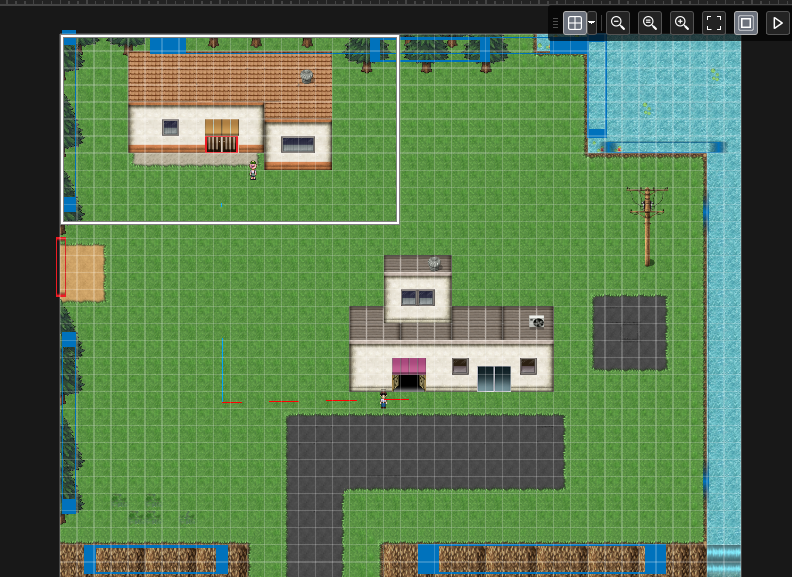
This was surprisingly a pain-staking task as well. To reach my goal of a technical prototype and then playable alpha prototype by next year, I wanted to start level design for some of the other places that would be available. Essentially, the Furukawa’s residence, which includes the large outside map, the inside of their house, (both of which I completed this cycle), the interior shop and Mei’s room (above the shop).
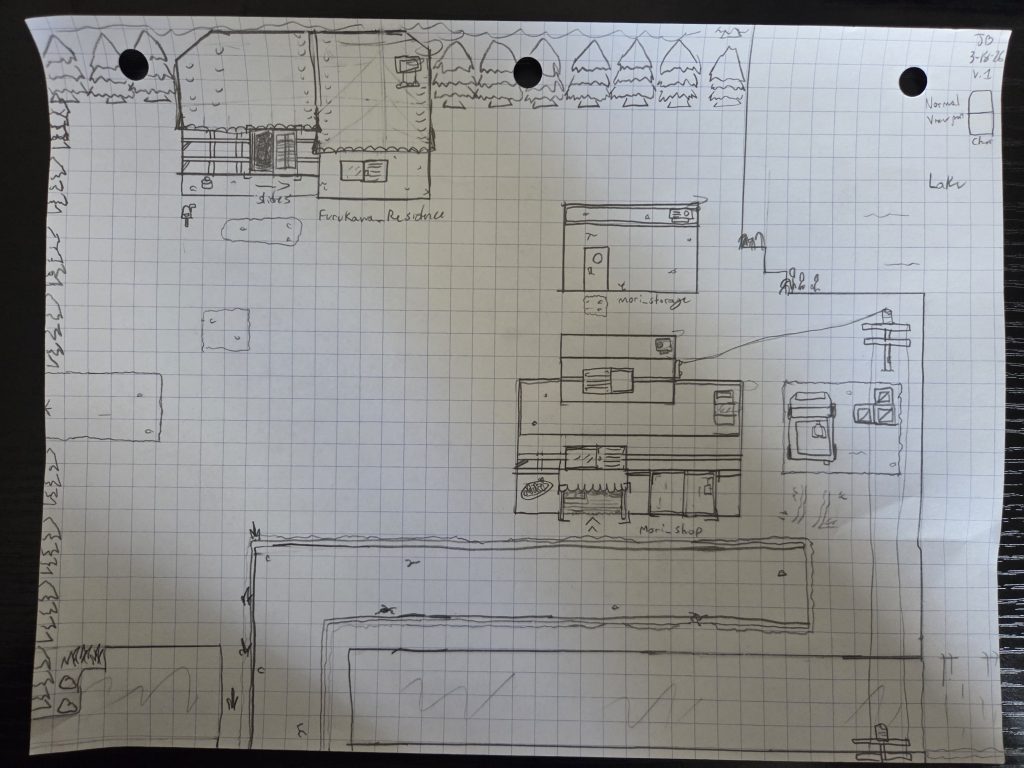
This map took a few hours and is based on the concept art I drew out by hand:
Uncle’s shop map, sketched concept
I have decided to patron the Kokoro Reflections tilesets. They were really kind in answering my questions and I am happy with their products so far. Importing their tilesets lead me down a path of learning about Gamemaker 2’s texture atlas and auto-scaling. I now understand the use of the texture page sizing as I spent some time trying to figure out why their tilesets specifically (the ground tiles specifically) were being stretched and ruined in run-time. It was because the source they provide for their non-RPGMaker files are massive in dimensions, and the base texture page of GM2 wasn’t able to handle that appropriately.
So, I had to do some changes to the memory config and I decided to load up all the NPC sprites and animations into their own group as well to help ease some load times during game play.
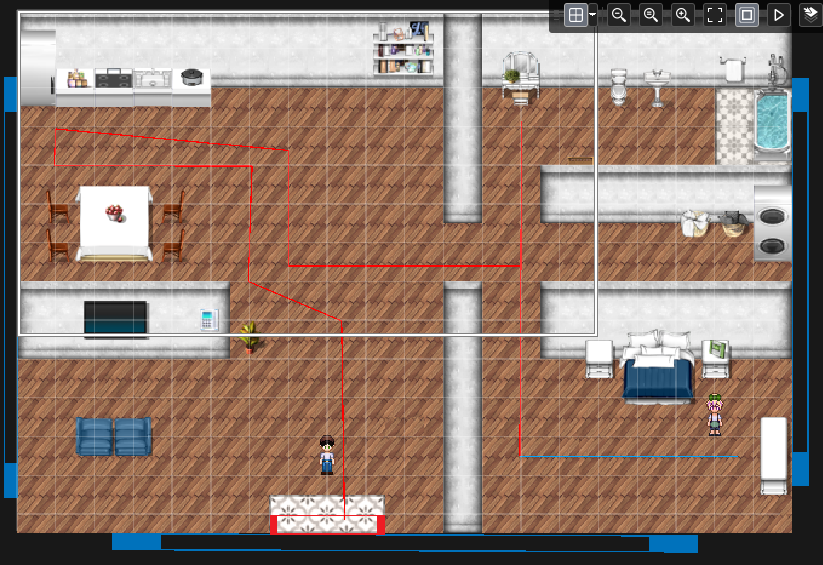
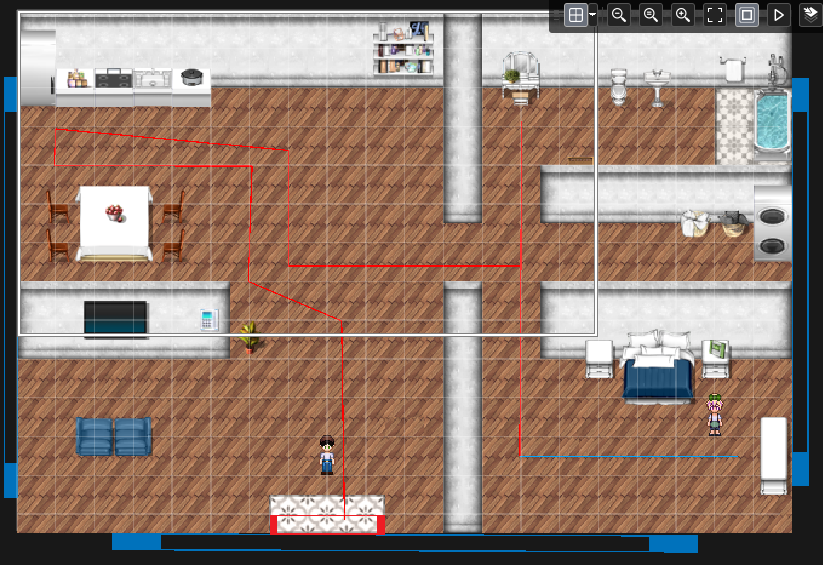
The inside of the house so far. The lines you see are the IDE showing the paths I have in the map. This leads into my next subject.
NPC Schedule Persistence
I had talked about the Scheduler system in an older post, but it was time to update it. Similar to the problem with Object Instances and data, I needed to make some tweaks to have the Schedule system seem persistent. In many of these games, all NPCs run on schedules: these are paths to follow, places to be at at X time, and so on all dependent on the day of the week, the season, the event, or other conditions.
I am an extreme visual learner and thinker, with logic coming in second place. So with some back and forth, the current solution I found is to piece together the schedules on a room load and then send that information to the instance of an NPC so they can find out where they roughly should be for the current game time. This works great if you have static placements for characters, but I currently have functions for them to follow paths, leave rooms, and wander around.
The SpawnManager helps with the “leaving rooms.” Instances remain with collision even if you hide them, which means I had to add a helper function that essentially moves NPCs that are “gone” from the map to a -9999 y point, and then draw them back to where they belong when needed.
Paths are the interesting dilemma I had here. By default they work, but the problem is continuity. I found that if I entered the house, Miyuki would start her path, but if I exited and re-entered, she would re-start the path from the beginning. This makes sense, because the function Scheduler sends to the AIController was to simply follow the path asset. To fix this for now, I added some logic to these systems that reads the number of nodes on the path asset, and based on the time start of the path task and the start of the next task, we approximate which node they should be starting from on room create.
For a path with many nodes like in the house, this works relatively well, but for a simpler path, it’s not quite there. I am thinking on if there may be a way to mathematically get the total number of in-game seconds each travel will take and more accurately start the points that way…
Sound!
What’s an H-game (or any game) without sounds? The big piece of the last two weeks was implementing SoundManager and getting audio assets imported in for BGMs and SFX. I have these load into memory similar to all Sprites in which we load their asset groups on GameInstance create so they’re ready to play. I wanted to future proof for the Options system – hence the need of audio groups to control gain on each one – and level design, so me (and maybe future team members?) can easily override based on certain maps to play specific tracks.
There is an “overworld”, “custom”, and “silent” mode setting that you can use per map. I am designing an audio group to manage all background music tracks, all sound effects, one specifically for H-content sounds, and a placeholder for voice acting (if that ever happens).
Current state of the prototype (VIDEO):
There were a lot of small tweaks as well, and I still have dialogue writing and item wiring to go through. I’d like to release a technical prototype build on the new itch.io page by August for some initial interest building and bug reporting to help me make a more polished, playable prototype by next year!
Greetings! Senpai here. It has approached nearly a full month since I last wrote about the project. Now that I have stepped away from the grindstone and am taking time to look at changes thus far, I can say there has been an laudable amount done in the last 25 days!
NSFW warning: content not suitable for minors ahead (obviously).
Psst: this is a lengthy and technical one. If you just want to see images and video, jump to the bottom!
Relationship System has begun
One of my internal to-do’s for April was to begin the Relationship System, and that is what I have done. For a while, I had formulated the base idea and then refined the process with some research and back and forth to understand what might be the best mathematical representation for relationship progress.
Project FH under the hood calculates relationships and their interactions in a layered formula. First, the success of interactions is gated by each NPC’s “interest” stat. These are:
sexInt – How interested they are sexually, gates sexual interactions.
romanticInt – How interested they are romantically, gates romantic interactions.
friendInt – How interested they are in being friends – you get the picture.
These three variables act as stats like Charisma or others would in a game of DnD – you roll based on the formula baselines of success (factored by other things) and these act as your “+3” to the roll essentially. The idea with these stats are to allow for playing with interactions in different ways to get to an outcome in some other way.
So we will use aunt Miyuki as our beloved example.
If her starting stats are set to relatively tame ones, such as:
Trust = 100 / 500
friendInt = 100 / 500
Lust = 90 / 500
Perversion = 90 / 500
Relation Level = 3 / 10
SOC_STATUS = Normal
RELATION_TYPE = Neighbors
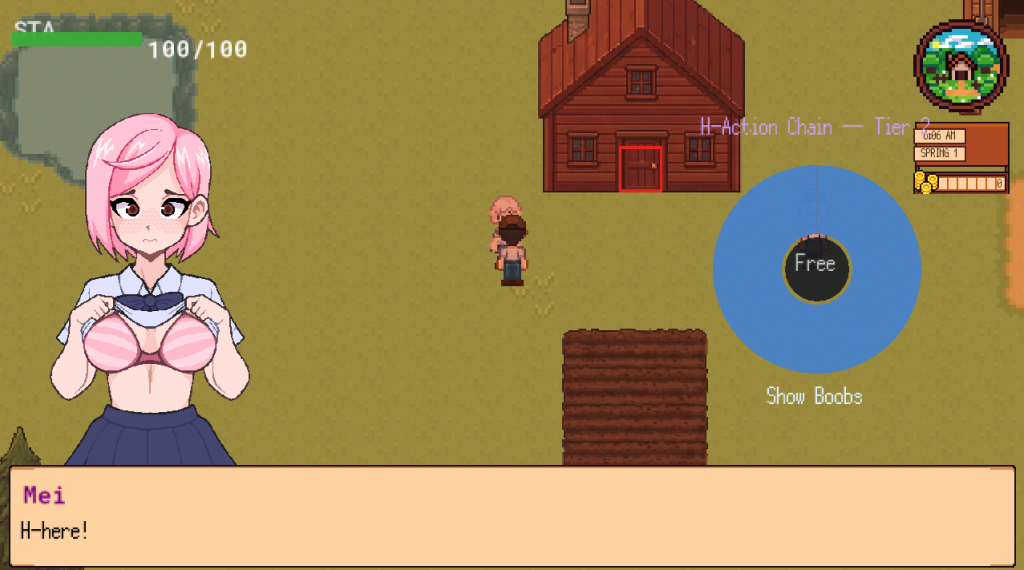
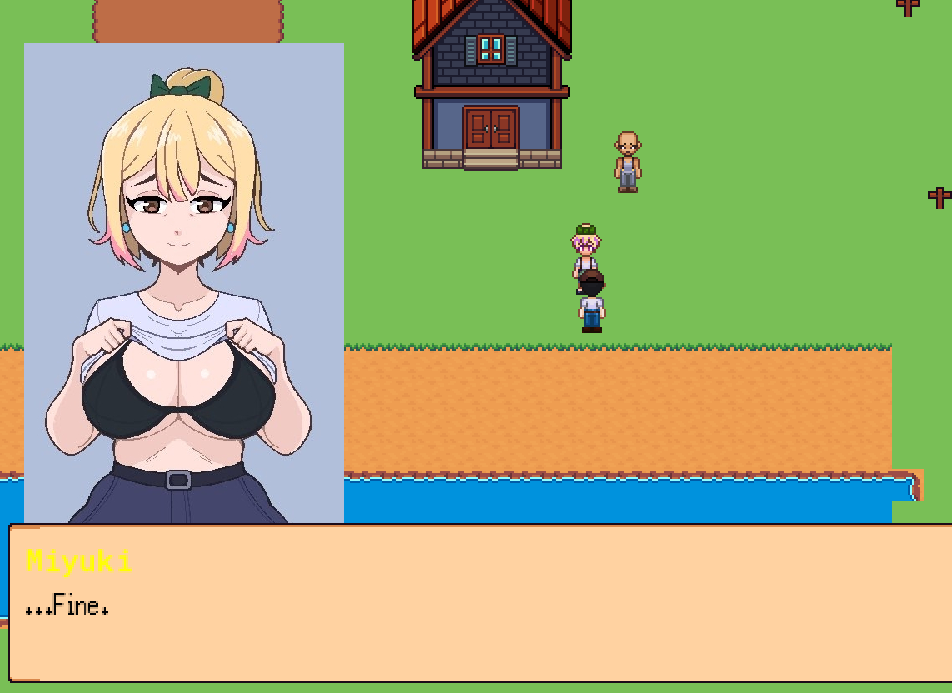
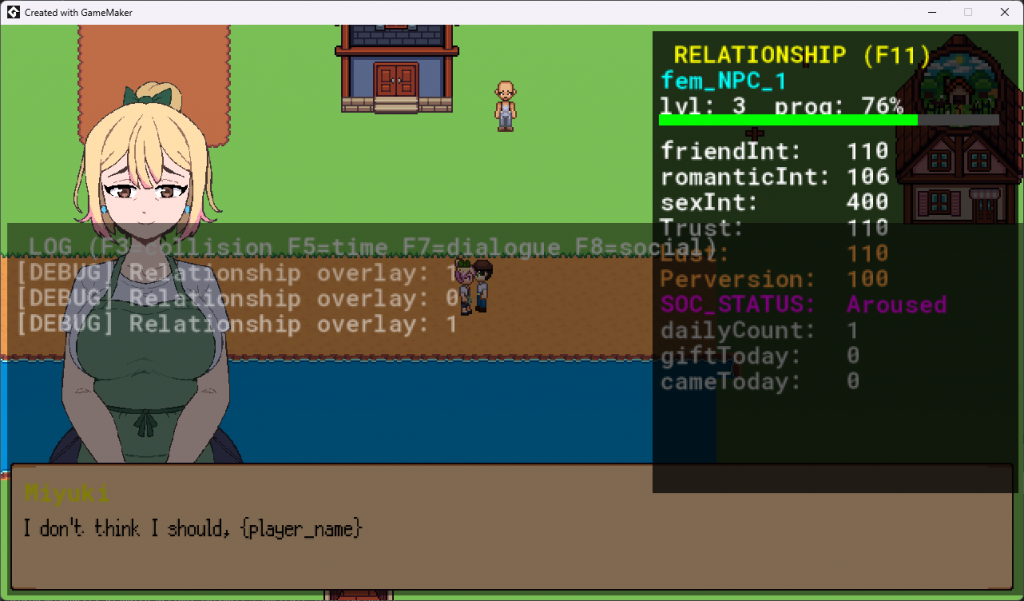
BUT, we set her sexInt stat to 450 out of 500, we are likely to succeed in SEXUAL interactions, as seen in the screenshots resulting from these variables:
With those stats, even though we’re not Friends, Lovers, FWB or whatever, her sexual interest in the player is almost maxed out, so using Perv skills like “Show Bra” -> “Show Boobs” even up to “Paizuri” all worked.
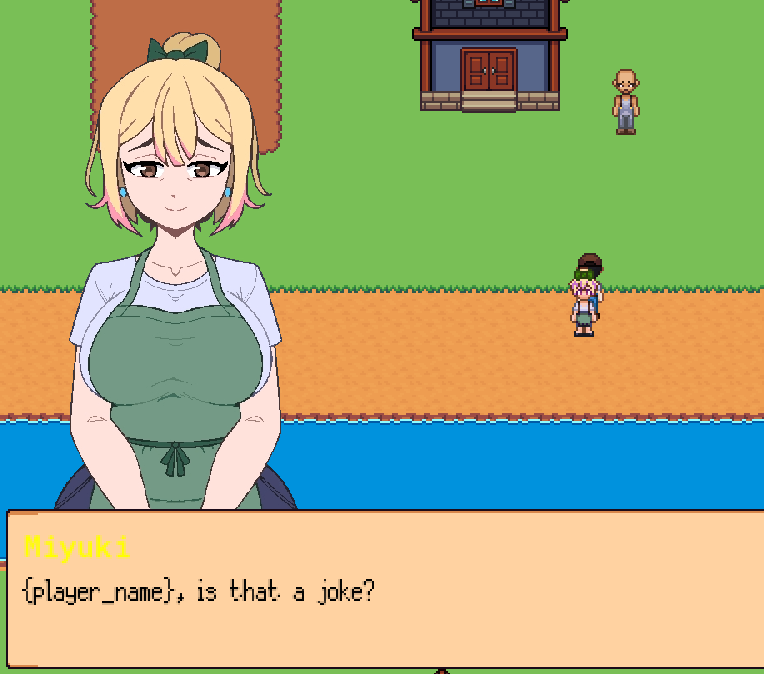
When we had the variables down to normal levels again, including setting sexInt to around 40 out of 500, we get an expected rejection when asking her to show her bra off:
Senpai, why allow this possibility?
Because it is a fun idea! My goal for the core design of Project FH is to have the personal interactions mimic real life a bit – people are not two-dimensional like most farm sim games make you think. You don’t just compliment a bunch and give them what they like. Sometimes, they may be sad or upset and even a gift they love might not help much. Sometimes, if you flirt enough or give them a “special item,” they may be willing to mess around even if you’re just Friends or even acquaintances.
Some may even be willing to hate-fuck if they’re angry with you. The possibilities are limited realistically, but the feeling to the player is that of control on the experience. This is the type of formula that makes interactions in games like Baldur’s Gate so fun – there are obvious points of entry, but so many other ways to achieve a result!
Other considerations for Relationships
The overall flow, anytime you interact with a character using either a Social Skill or Perv Skill/H-Action, the system calculates in a few steps:
Layer 1: interest stat checks.
This uses a lerp(minChance, maxChance, stat / 500) to calculate the success or failure. This is why if sexInt is nearly maxed out, you will almost always succeed.
Layer 2: SOC_STATUS adjustment.
SOC_STATUS is a list of the social statuses an NPC has. These are essentially how “mood” acts in a game like The Sims. Essentially, each status adds a pre-set amount of additional chance. For example, if Miyuki is currently “Horny” but her sexInt is only 120 out of 500, you add an additional nude anywhere between 20 – 30%, making it likely to succeed.
Layer 3: pass to updateRelation.
The interest check determines fail or pass of the skill. Either outcome requires that the updateRelation() function increases or decreases your overall relationProgress value with the character.
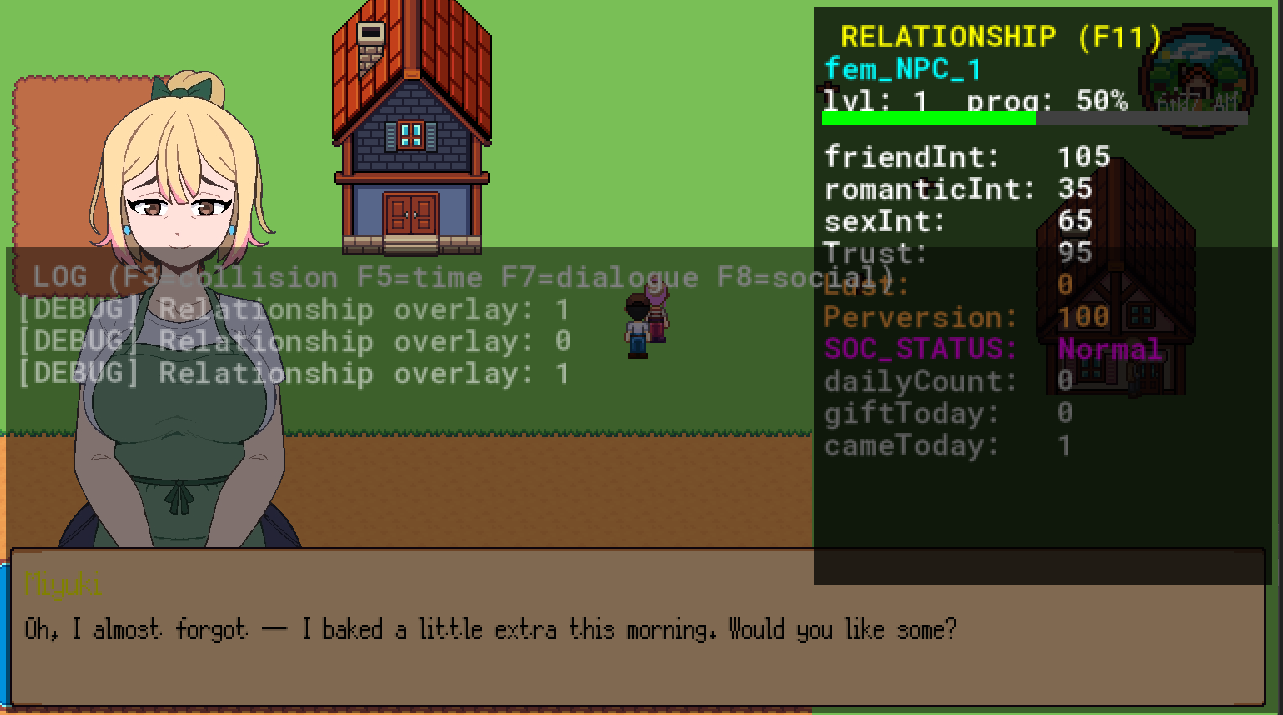
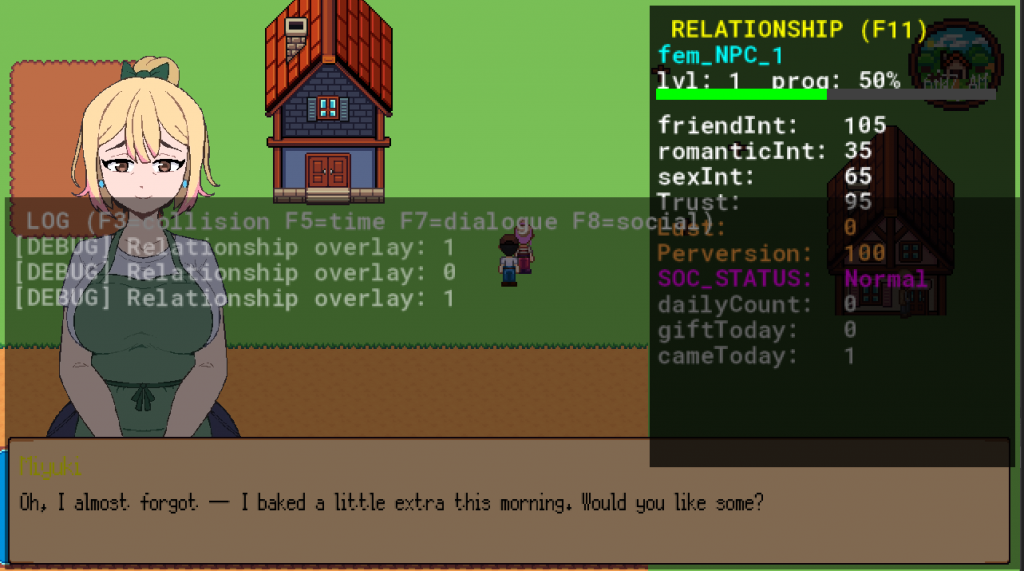
In this screenshot of the debug overlay, we see the stats and the current progression. You will notice diminishing returns with each interaction, where positive interactions stop increasing it overall after the third time – but be careful, negative ones will continue to degrade your relationship!
Concluding the Relationship System
Overall, I am happy that the foundations are here. I have a GML script that runs test cases to check the math, and currently had them hit all positives so far (but it funnily destroys the framerate when ran). This system will grow in scope surely as I proceed and things are removed and added from the master design. It’s really cool to see math gate the interactions and make this once dead NPC that was spinning out on a path act like a human!
A Better DialogueManager (for content creation)
Though DialogueManager had existed, I immediately noticed its deficiency when trying to write further JSON content to power Miyuki’s dialogue. Basically, before this dev diary, the data structure was like so:
miyuki.json

"conversations":
  {
    "miyuki_greet_default",
    "conditions",
    "priority" : 0,
    "lines": [
         lines
     ]
},
{
    "miyuki_horny_initiate",
    "conditions",
    "priority": 0,
so on
The old version was making assertions on context strictly by the NPC KEY [“miyuki”] and the skill id [“paizuri”] and using a special function to handle openings always as greetings.
The problem with this is it was technically possible for the completely wrong dialogue to play out in any context. I realized this as I was writing the dialogue where, if Miyuki is horny and has the right entry conditions, we would offer to perform a service for you – no skill dispatch needed. However, the DialogueManager couldn’t really know about context at all here – it only knew the combination of NPC Key with Skill ID: things like greetings or special dialogue were all up in the air with little control outside of the writers having to plan each dialogue condition specifically around this design flaw.
So a refactor of DialogueManager was done which touched other systems. However, control and content creation will be MUCH easier. The new version allowed me to remove the middle-man document that mapped all dialogues for things and let all that data – along with its context – in its respective owner’s JSON file.
This includes nesting all dialogue under their actions/skills with variants:
The new data structure starts everything with the action, such as the “greetings” you see. This means we now truly have an organized list of dialogues per pool for each NPC, supporting different variants and making it much easier to understand the context.
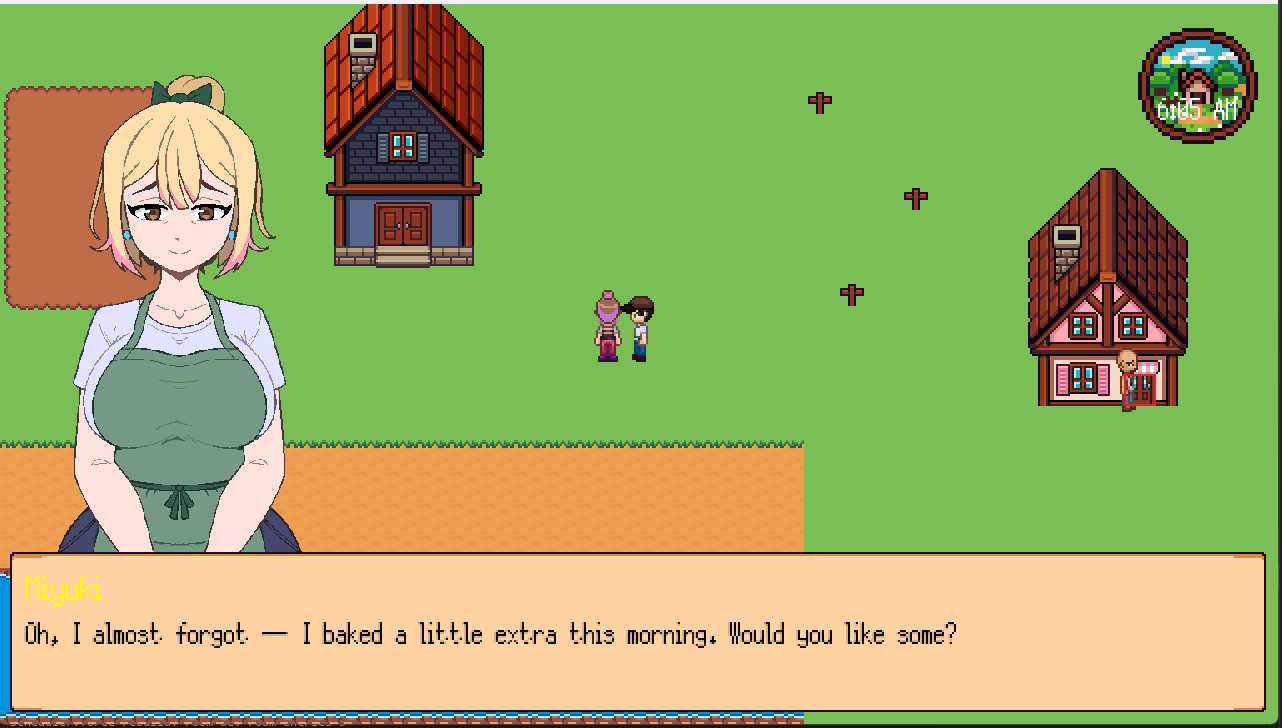
Here we can see the result of an alternative greeting. One in which Miyuki’s SOC_STATUS = Horny, matching the conditions of her horny_paizuri greeting:
Some other changes had to be made, as these special greetings essentially fire off an entry into the same skill-chain as if you picked “Perv -> Show Bra -> Show Boobs -> Paizuri,” but now context is passed so it can skip to where you need or control as needed. In this case, Miyuki skips the formalities and gets straight to it.
So that took a good amount of time to refactor and get working. But I am now in a place where I feel like a blocker has been removed – I can easily write in the JSON data and make dialogue for all NPCs way easier without having to juggle the conditions vs priority for all of them.
Let there be (day)light and menus!
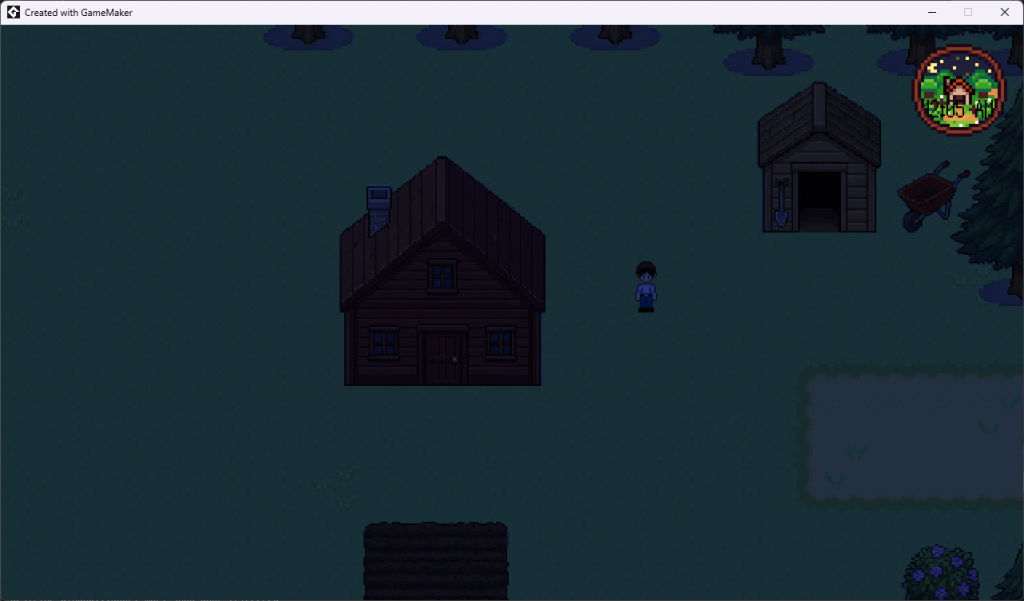
I do this weird thing where I am working on a feature in a git branch, and once I am done with it I decide to start something else in the branch. So the alphaRelationship branch merge also includes a daylight system and the beginnings of the Menus!
Screenshots only here as I have bored you long enough with the technical talk:
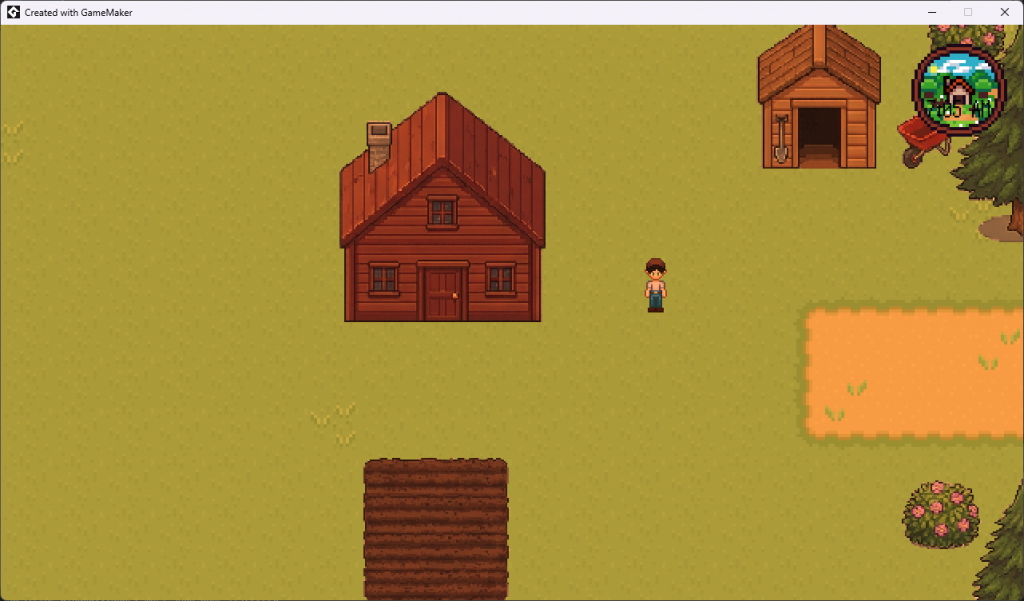
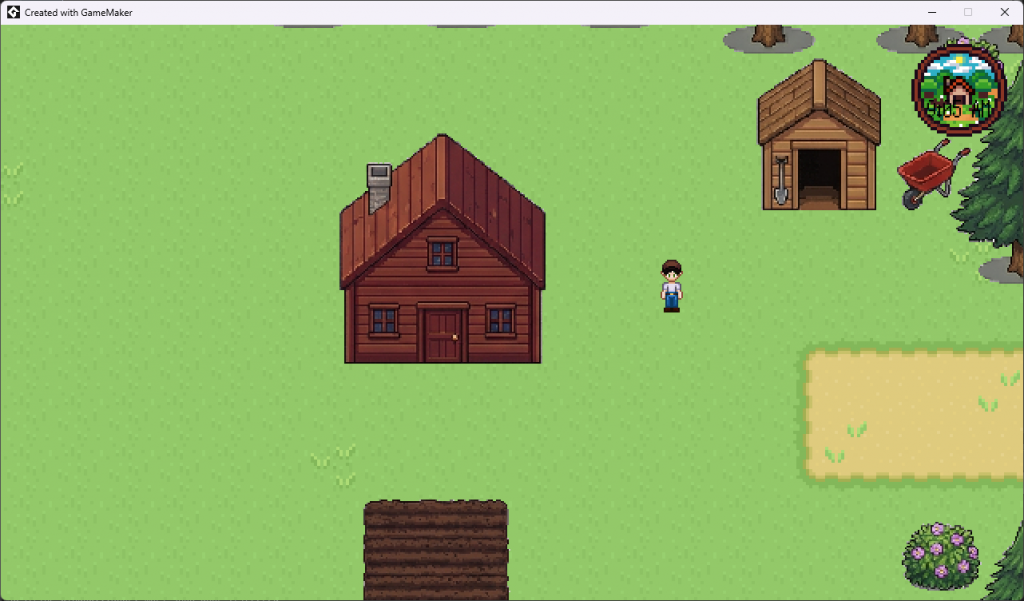
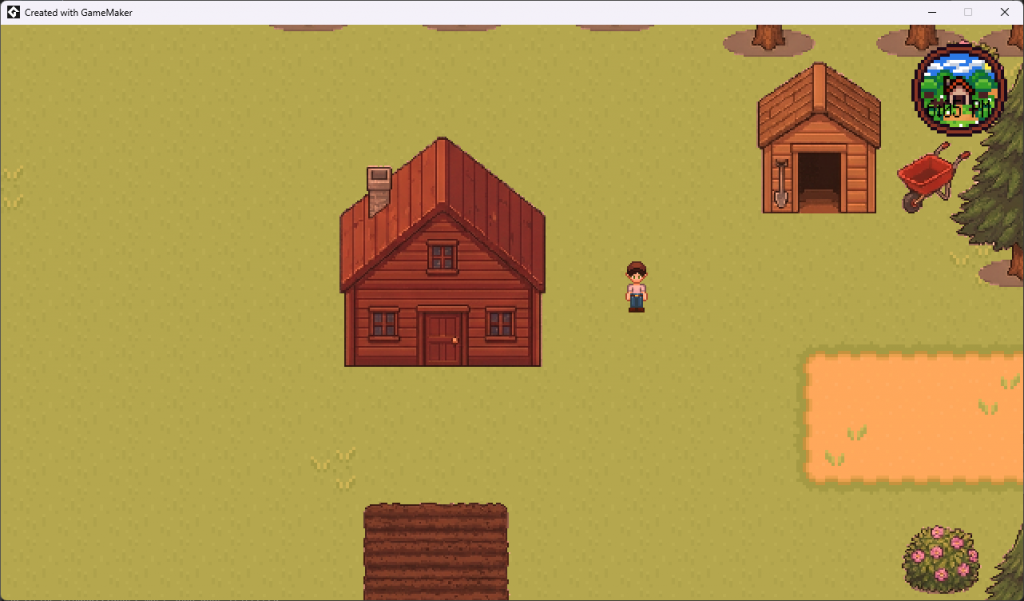
Early morning
Daytime through afternoon
Evening/sun is setting
Night – late night.
This all syncs via the current hour in the obj_clockController. GUIManager draws over the screenspace with tint and hues to mimic daylight. This will expand for weather once that gets implemented later in the year.
Menus
I purchased a cute UI asset from itch.io to test out some graphical menus. It’s clunky and using junk/placeholder data, but we have something to utilize when pressing the escape key now:
Conclusion
It has been a productive month for Project FH! I am going to finish up more tweaks and small changes before taking a decent break from it in May. I am also continuing to work with the legend Neme on art assets for Miyuki right now – including a first animation for one of the H-Actions! I will be sharing that demo video on my Bluesky Account when the time comes, so you can see the true final vision of how it will “feel” interacting with the ladies in Project FH.
After the break, I plan to tackle getting the data for all items ready and implemented so we can expand the Menu system and begin the actual Farming part of the game. Once those pieces are done, I anticipate by late 2026 and early 2027 to have content made for more NPCs.
My plan is to have a very very early-alpha playable version released via some means (likely to be Patreon). This is my personal goal for the build so I can start funding this project (by that, really just funding wonderful people to contribute to it).
Like with the first dev diary, I am providing a non-committal but idealistic timeline for you to expect on this project:
June-August:
Item and Inventory system v1 implemented
Final tweaks to Dialogue and social systems
Finish all dialogues for Miyuki NPC
Finish all dialogues for Hiroshi NPC
September-October:
Official artwork for Hiroshi (just default spring outfit with a few expressions)
Official artwork for Mei (Hiroshi and Miyuki’s daughter, spring outfit portrait, expressions, some H-action art)
Content: full schedule built for all of year 1 Spring for Miyuki, Hiroshi, Mei
Farm system v1 implemented (for spring crops only)
November-December:
Alpha main menu and settings implemented
Finish the early-alpha playable prototype maps (includes: Farm map, Furukawa House Map, Player House Interior, Mori Shop Interior, Furukawa House Interior)
Finish the Tutorial Quests and implement QuestManager
January-February of 2027:
Release the first ever playable prototype. This will include:
Year 1 Spring ONLY
Only three NPCs: Hiroshi, Miyuki, and Mei Furukawa
Only the exterior and interior maps for the Farm Land and the Furukawa House map
The first iteration of the final game’s tutorial and opening scene (SceneManager put to work!)
Expected interactions you can do:
Miyuki:
All social interaction variants
Show Bra -> Show Boobs -> Paizuri
Show Panties -> Show Ass -> Buttjob* (if funding allows)
Mei:
All social interaction variants
Show Bra -> Show Boobs
Show Panties -> Show Ass
Hiroshi:
All normal social interactions
Special interaction if he is nearby when performing a Perv skill with Miyuki
This prototype build is the current end-goal to serve as a proof of concept and get people interested/hyped about the game! I need to establish it in a way where I can fundraise somehow, as the art assets needed for the final full game (which would take a couple of years to reach) is non-negotiable for me.
Hello hello and welcome to another dev diary 4. A little over a week since the last one, but I have put in some significant progress to this week’s goals. So, the juicy behind-the-scenes screenshots and early footage you will see will be pretty different from the previous post’s.
During this last week, I wanted to tackle two things: start exploring other sprite work assets available out in the world of itch.io to use for prototyping a “feel,” and the Scene Manager system.
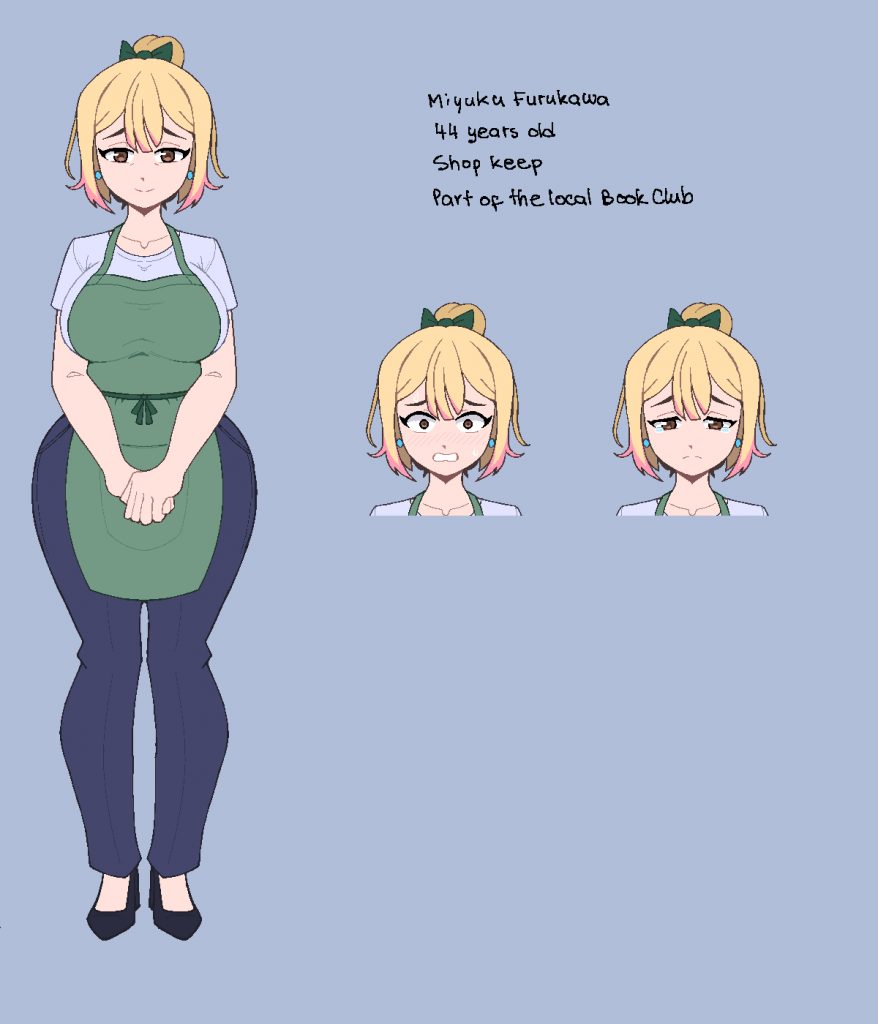
During this time, I was also working with a immensely talented artist recruited and commissioned to get a basic character sheet and usable portrait of one of the first characters you will interact with – Miyuki!
Miyuki is your aunt-in-law and spends most her days operating the town’s local general store. I am super stoked to see the vision I had come to life in this way and can’t wait to get the art-train going even further as this little hobby-project grows into something more.
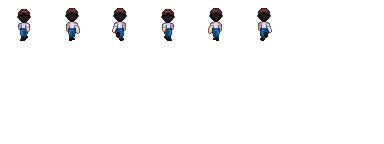
Additionally, I have tried out the Memao Sprite Sheet Creator. This specific tool (which I can recommend for other indie devs needing some assets asap) helps you make overworld sprites with a variety of options. They have extended it to allow custom assets and connect them via JSON but 1) I am no artist (best I can do is draw poopy maps) and 2) I have other things to do right now. But it’s a cool little program and the style of overworld sprite is definitely the type of thing I am looking to utilize.
The strip image imported in GameMaker is a little wonky with how it builds the cells to cut out from so I have had to manually export a sheet for each movement and its direction to avert this.
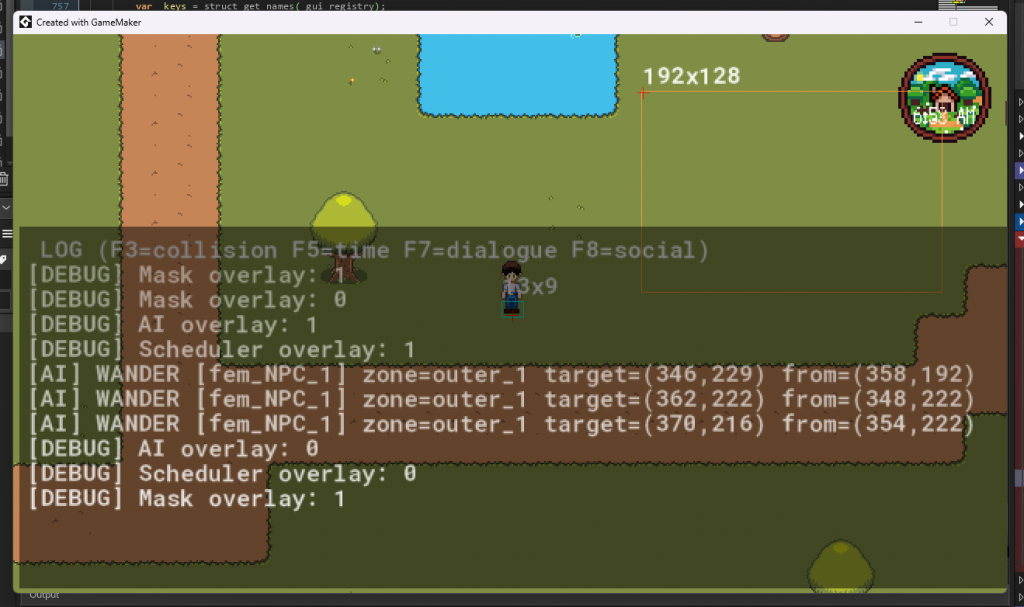
I also set up a second room to test how rigging up additional characters, spaces, and paths feel. Also peep the debugging system – you’ll see the masking box on the sprite’s foot. This was a side implementation I did in the middle of the room test because I got tired of manually setting the masking boxes to the characters each time I change the sprites. It’s been a game changer.
Now we move on to part two:
The SceneManager script
The video above at the start shows a crude “scene” in FH. This is all done by a script in run-time. I know, I know. I have heard that you can use Sequences in GameMaker, and maybe in the future that will be the best route. But for absolute control, I have taken the path of setting up another constructor that feeds off a registry file that has the nodes that build a scene.
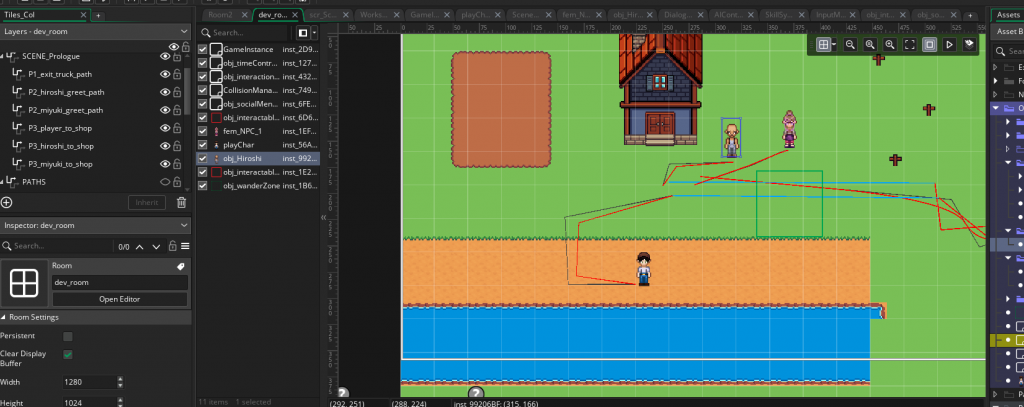
This registry file essentially lets you write out the structs of each node or “step” of a scene, and its main action. These are move_path, move, expression, and dialogue. Right now, my test prologue scene is using paths drawn in the room that get called by the SceneManager when it reads the structure:
This is a view of the pathing in that room for this scene. I might re-think some of this system, because having to draw all the paths for each scene that would take place on each map seems like it will be chaos for the room editor in the future. Perhaps I’ll just set a point and have the SceneManager use the same logic from the AIController to draw a path in run-time? I dunno, but this is what I have so far.
And it works! It’s crude, and it took a few hours of debugging other systems. DialogueManager needed to understand the difference between when it was running in a scene versus in game-time. This is because when a scene flips, the in-game clock and all AI schedules pause and stay that way till it is flagged as finished. I had it designed to work with an “InteractionManager” which I failed to account for – so there was some tomfoolery to get it all fixed. So now I can have it distinguish between in-game dialogue and scenes.
Anyways, to cut it shorter – that’s the progress within the last week and some change. We’re moving at a good pace – once I get all these foundational systems set and polished off, I’ll feel more confident to start spending more dedicated time to writing (dialogue, characters, quests etc.).
It’s no big surprise that I think the ideal career is one of a game director/developer. I love video games and have my whole life, and one of my favorite aspects of video games are their elevated ability to tell a story, to make you feel things. This lofty opening is simply to provide my passion behind the subject, because while I have several ideas of fun games in the chamber of secrets, this update and the next several will be around a project for a NSFW game – a hentai game, if you will.
Back in late 2021, I was actively writing demo scripts for a game I call the “dream project,” and while it has been indefinitely on hold, it is not without reason. I had enrolled into a Computer Science degree program to force myself into a deeper understanding of the principles of software design and development. Along that path, I took some game design courses that expanded my knowledge on how we approach game design and project management. During the degree, probably two or so years ago, I was friends with a friendly guy from Canada that ran his own software development firm. He has all but faded away from my life, but I still recall during one of his random pop-ups a conversation we had had: we discussed my further interest in advanced CompSci topics and then discussed my want to make games. This brought up the interest in doing a hentai or adult game, primarily for a shot at financial success that could be reinvested further.
That is not to say this project does not contain any passion or aims to be a soulless cash-grab: on the contrary even. Currently titled “hmSpirit,” this is a 2D project being prototyped in GameMaker, a software I have been interested in using for some time now. As 2026 started, I decided if I had a resolution of any kind, it would be to kick it in gear with working on projects that put some of my degree to use (I am now graduated as of writing this!) Within just the first few weeks of 2026, I have already learned so much about the engine and got a ever so slight grasp on my approach to making a production-grade project by the end of this.
Introduction to “hmSpirit”
Code named “hmSpirit,” the project is currently to prototype something that will aim to be one of the best adult Farming RPGs. It is essentially a merge of my enjoyment of the doujin hentai game world and farming sims/RPGs. I know that there are a good few of these that exist on the market, but I personally feel none of them go far enough to provide a solid game experience all around. In fact, that is my complaint with most H-games: more often than not, core gameplay loops are neglected for quick thrills.
You may say that is the point, they are literally porn games, and in some cases you may be right, but there are many classic Eroge or H-RPGs that have attempted a balance, and I want to strike on it and then some! While I don’t believe it will end up being on the quality of Stardew Valley, my vision is a core farming RPG that is well-done enough that people wouldn’t even mind if it never was a hentai game as well. But, my personal motto is “I want to make games I want to play,” and I love farming RPGs and H-games, but there isn’t a fun one that merges these for something you could sink say 50-60 hours into on just enjoying the gameplay loop and world alone.
My idea, as much of it I can share, is to focus on one of the features I always love in any RPG when it’s incorporated (especially in Farming ones): relationships. A farming RPG without relationship mechanics is like a car without oil: you just can’t drive far without it (or at all, depending on the car). A big focus on the master Game Design Document (MGDD) is how the balance between Farming and your relationships are. To grossly summarize it: the quality and output of your farming endeavors will effect how your relationship endeavors with the NPCs, and vice versa. And not just in a positive way! Another important design philosophy to me is to design systems in a way that even if they’re limited in technical scope, they can be manipulated by the player to play the game again in many different ways.
In one player’s save, they may choose to play it like they’re playing something like Stardew Valley – farming, becoming friends with everyone, unlocking all the secrets, and maybe do a little tomfoolery with their wife/husband/partner of choice on the side. Another player may choose to go full pervert-eroge gamer mode and focus maybe a little too much on the erotic aspects. I want there to be the freedom of choice there within this symbiotic system, but of course punish swinging too far in either direction (sort of like real life, huh?)
So, on paper a prospective player may look and end up seeing a relatively tame hentai Farming game, but in reality the project scope is rather involved. I hope I keep the steam going so I can update someday on my challenges in developing the inter-workings of these relationship systems, but for now, you can have my lofty visions and the actual updates as of now.
Design Documents
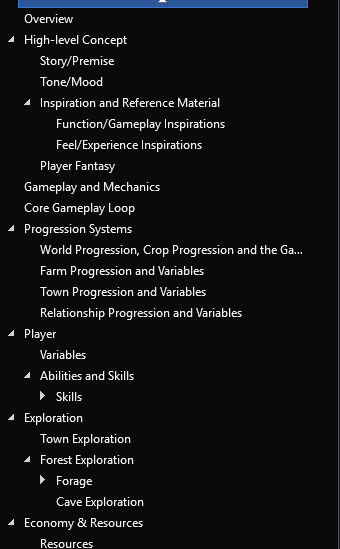
The Master Game Design document is currently at 28 pages and over 5000 words, which is actually on the smaller side, but is by far the largest GDD I have put together so far. It is still ongoing and like most GDDs, it will change as the project takes new identities, but this has been a fun creative outlet I have desperately needed for sometime now. Thinking out the high-level systems, the skills, the scenarios and gameplay loops has been a blast. I have plans to work on this a bit more to a first revision by the end of January.
I am trying my best to not tread into feature-creep too early, and so I personally feel my plans outlined in the GDD are on the slim side, but again, I want to prototype something playable with a solid foundation of design documentation before I ramp into actual production.
Game
This is the latest in-engine footage captured today. This is of course extremely amateurish. I am not too dedicated into programming the prototype yet, but I am trying to achieve the following while designing:
Get more acquainted with Gamemaker
Learn the engine low-level systems, functions, how to handle maps and tiles and draw orders, etc.
Set up basic boilerplate stuff, like collisions, depth, basic interactions, and basic AI (movement)
This is the culmination of probably just 6 or 7 hours of work so far – of course using assets I have purchased from itch.io. I am fine with premade assets for prototyping (you can find the tileset by Emanuelle here) – I have plans to commission or employ the works of artists once it is ready for a pre-production state.
Again, this video doesn’t show anything to brag about, but rather serves as proof to myself I am doing it. I am essentially taking up some hours throughout the week to handle all aspects of game production to trick my brain into getting into a locked-in state for the prototype. Under the hood, I am a little more proud, as I have been trying to wire this so that high-level concepts such as Character logic, input and collision handle in a reusable way and not copy+pasted per object. I may be making a hentai game, but I want it to run efficiently and be as bug-free as possible gosh darn it!
I also have active engine and script documentation going, so if by some chance other people come on, they have the idea right away (and so do I if I ever take a break…) I am going to play around with setting up a basic interaction/trigger to dialogue system soon and then focus on making the rest of the preliminary design documentation: the MGDD, character sheets, crude concept art (I am not a great artist), scenarios, etc.
Current (fuzzy) timeline for the prototype:
Jan:
Basic dialogue system
Basic NPC AI movement on paths and prepare for unique NPC schedules
Finish the MGDD
Feb:
Start Character Sheets
Start first “clean” test map in-engine
Start Character Dialogue mapping
Any bad concept art for characters
Mar:
Start prototyping the farming mechanics and in-game clock
Prototype UI elements (menus and inventory)
Start Quests outlining
Apr:
Dedicate to finishing design materials for first prototype
Finish up any lingering development items prior
June is a busy time at work, so I will likely not get to do much for the project then.
Jul:
Begin the prototype for the relationship systems
Begin prototyping cut scenes (to reuse for story and relationships)
I hope you look forward to more updates if you’re a fellow farming rpg and/or H-game enjoyer!
2025 was a lighter year in new game releases. For me personally, the year did not ramp up until after the Nintendo Switch 2 release. I had spent the early part of the year moving, flying out to stay in L.A. for a week, and finally taking care of boring adult stuff that comes with moving to a new place. However, as a certified gamer, I still surprisingly pulled off playing enough new titles to culminate into a Top 10 list, so let’s do that.
This list includes a game that is left unfinished, so I will mark it with a * in the list. This is more of a stream of consciousness on what I remember feeling when playing these games and less of an analyzed, well-thought critique of these games.
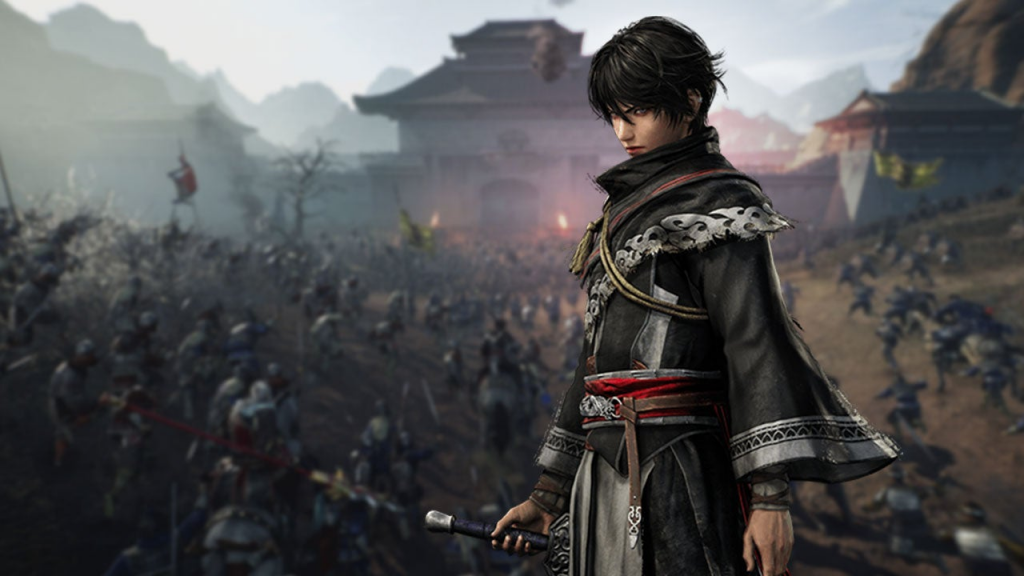
10. Dynasty Warriors Origins
When this game was first revealed it was safe to say I was decently hyped up for it. I loved the Warriors musou games growing up, and haven’t played one fully since Dynasty Warriors Empires 8. The graphics engine finally looked better, the battle scales looked larger – I was prepared.
January 17th, 2025 came and essentially went. I do like this game, but honestly its inclusion at the top of this list is due to having not finished many games or playing enough games at the top of the year. I may do an in-depth review/rant on this in the future, but while it was an enjoyable action game, DW: Origins dropped off so much of what makes the series a fun and replayable experience.
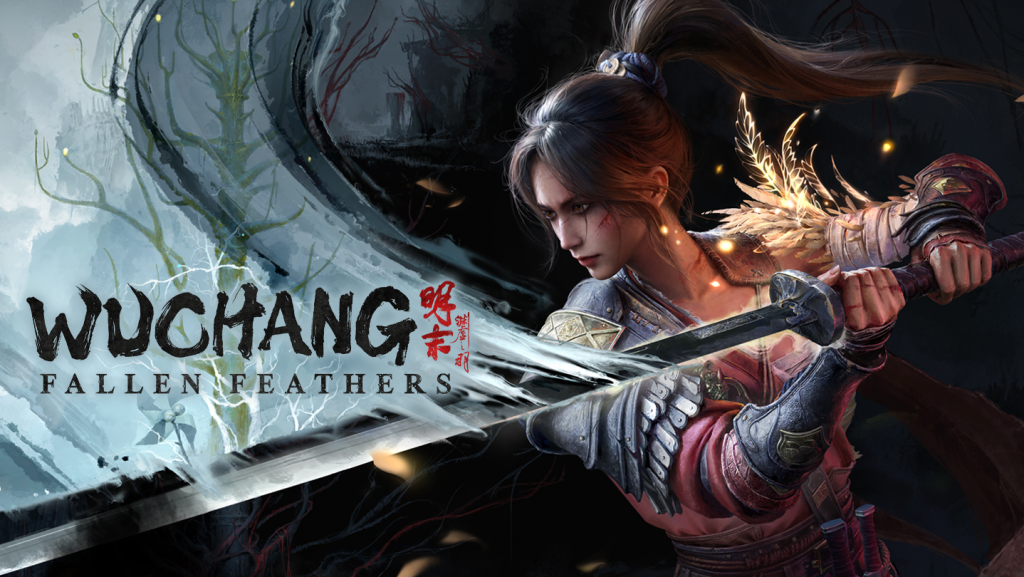
9. WUCHANG: Fallen Feathers*
This was a game I didn’t even know about until I saw it randomly on the Playstation Store’s “Upcoming” section. Pretty lady + dark souls is always a easy sell to me. And, after seeing Iron Pineapple’s video on it, I figured I’d give it a shot.
This is the game I have yet to complete, by the way. I won’t get too detailed, but the game is fun. It definitely captures the way I felt when playing Dark Souls (1) for the first time, but in a macabre fantasy China. The moment to moment gameplay is fun and there is plenty of challenge, but this game runs pretty bad at times (even on my PS5 Pro), and before I could even finish it, controversies with the player-base in China led to content being censored or redone before I could experience how it originally was.
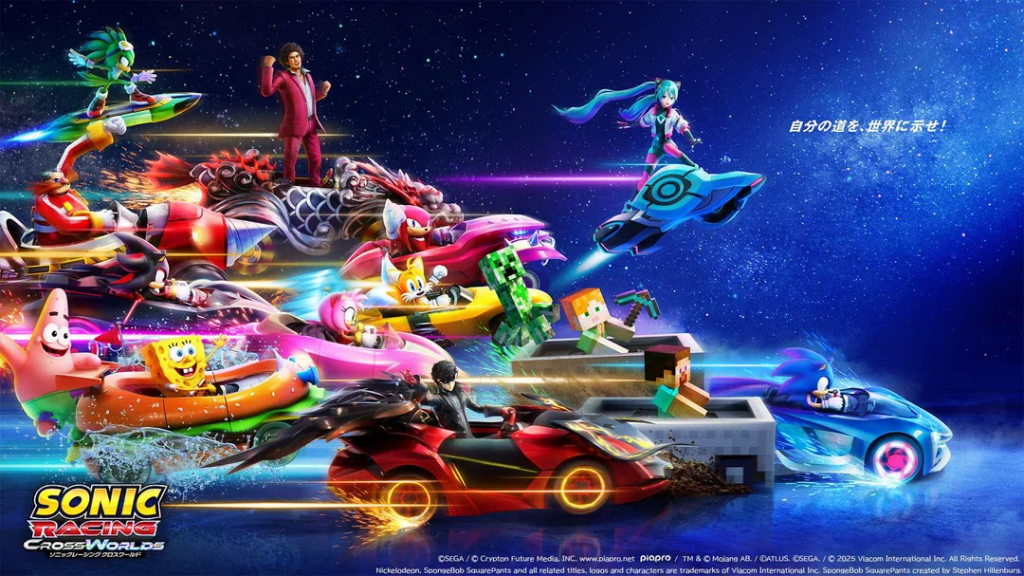
8. Sonic Racing: CrossWorlds
I was late to the party on this one. Let me get it out of the way: this game is way more fun than Mario Kart World (which is not on this list). To be fair, it’s hard to beat a racing game where you can play as Hatsune Miku.
I picked this one up for Black Friday and played a good bit with my friend. It’s by no means the perfect game, and it is plagued with a balancing issue that has yet to be addressed (you want to be in between 4th-8th place until the last moments of the game pretty much). There are also some sad looking graphics engine issues even on PS5 Pro, such as background characters appearing to be .gifs imported into the world. All that aside, the character selection is great and the racing is fun and feels good to control.
7. R.E.P.O
R.E.P.O dropped in February, but I didn’t play it until a couple months after. I had still felt full from my good 40+ hours in Lethal Company the year prior, but my friend saw a lot of clips of this game and wanted to try it.
It became a regular Discord get-together for us for a month there in 2025 and it was good fun the whole time. I know the game still receives updates from time to time, but it ultimately felt like there was a little less to truly work towards besides powering up. I absolutely love the ways you can try to kill the monsters too – the sleep dart gun is top tier!
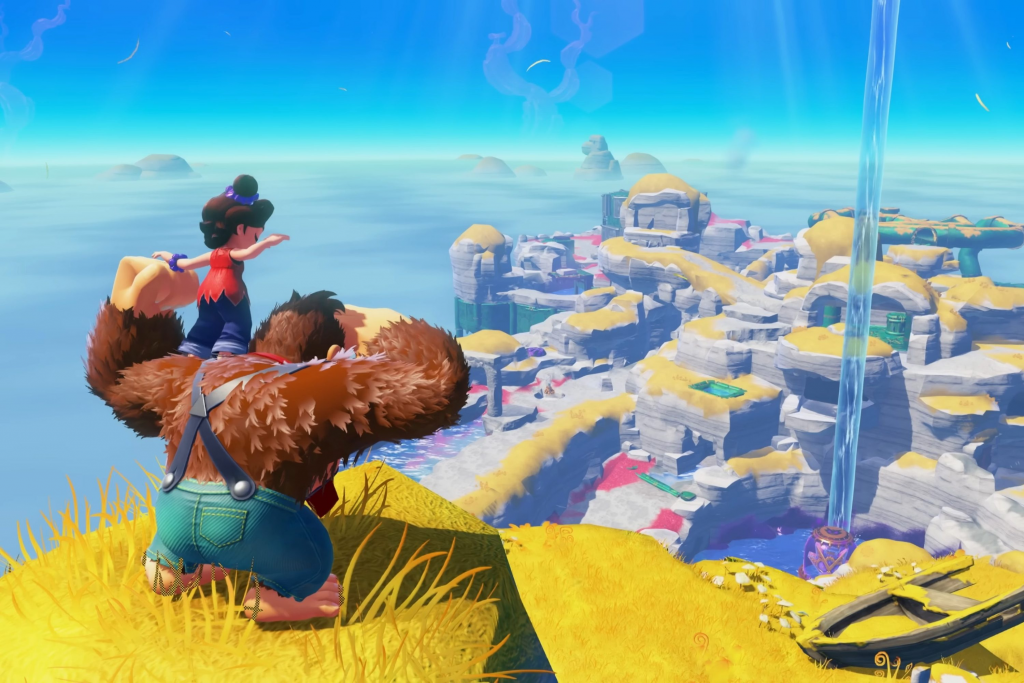
6. Donkey Kong Bananza
We finally get to the Switch 2 games. I was up past midnight picking up the Switch 2: despite the online discourse, I was excited. DK Bananza looked like fun, so I picked it up. I don’t really play any sort of platformer-adventure games often (if ever), but admittedly the Switch 2 was sort of dry at the time, and this was the stream of water it desperately needed.
This game was a blast – early negative reviews be damned! I played primarily in handheld mode and enjoyed smashing entire blocks of terrain, collecting all of the fossils and running around to get the Crystal Bananas. This is a solid game, which explains its nomination for Game of the Year at The Game Awards 2025. The only real complaint I had for DK Bananza is it overstays its welcome in the story and could have been shortened just a touch.
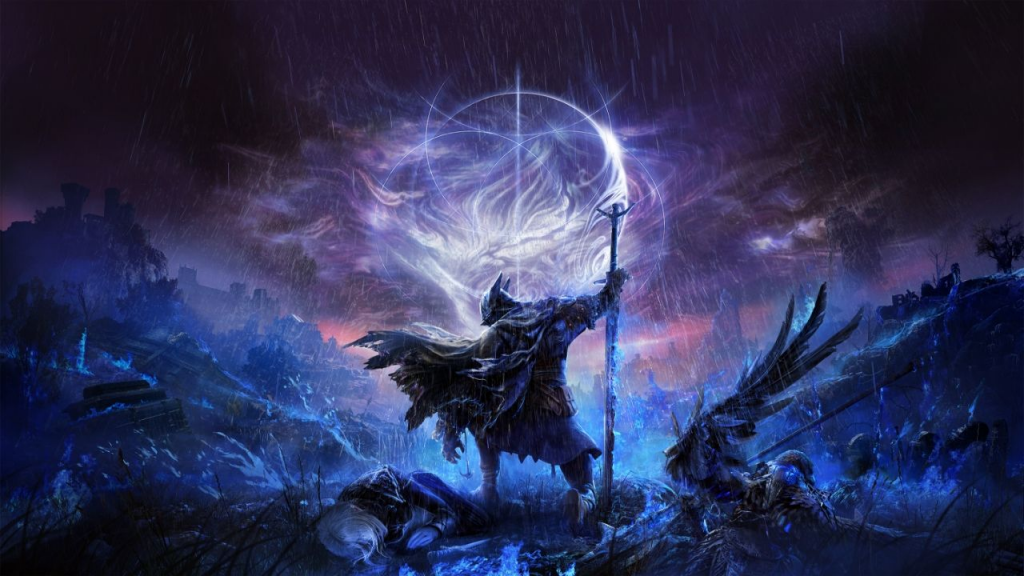
5. Elden Ring: Nightreign
I am an Elden Ring lover. I have played Dark Souls 1 and some of 2 and 3, so I may be called a poser, but Elden Ring was an insane release back in 2022. I even 100%’d it – I love this game. So when Nightreign was announced to be a co-op roguelike spinoff, I was somewhat skeptical but still excited to try it out.
When it dropped, that excitement was validated. The game is essentially co-op runs through a mashup of the Elden Ring maps, where every second counts to level up and get better weapons before the Fortnite-esque storm consumes you. I 100%’d this game as well and enjoyed many sessions with my friends, but now that the DLC has dropped, I found myself not as eager to come back as I thought I would. I’m sure I will come around, but the DLC expansion did not demand my immediate attention.
4. Monster Hunter Wilds
This was the game that tricked me into believing I needed a PS5 Pro. Some background: I was in the middle of a move when initial reviews were dropping, and the game looked like a lot of fun. But performance issues on consoles were noted, and many had said that PS5 Pro was the definitive way to play this title. I’m not super sure about that, as it still has some embarrassing hiccups on it, but regardless, this was a fun addition to the series.
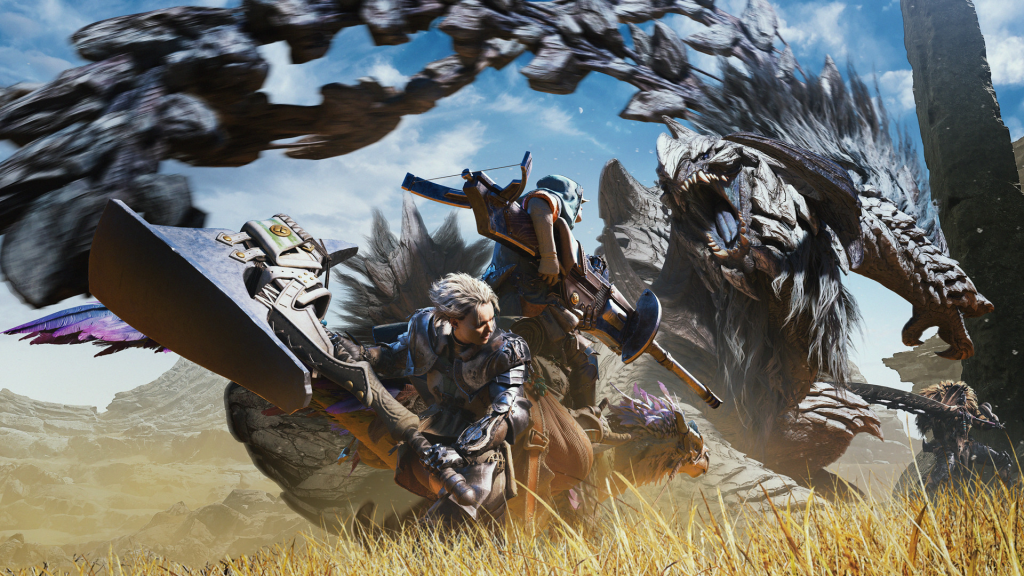
Another one I spent a good chunk of my Spring on and it ended up 100%’d as well! As an Insect Glaive main, I wish the feel for the weapon was retained from MH Rise. Instead, it is back to the sheepish jumps of World, but with the addition of the new special attacks, I can forgive it. It really does suck Capcom haven’t quite pushed to eradicate the glaring performance issues yet…regardless, it is more than playable and what you get to play is a blast.
3. Umamusume: Pretty Derby
Yes, my top three starts this way and I am not ashamed. I was a fan of Umamusume Season 1 back when it aired originally. At the time, I did not know it was planned to have the game come out first, and then it wasn’t until the Global release earlier in 2025 that I even knew there were multiple seasons, a movie, and that Japan had the game for some time.
Although it took me a minute to understand the actual gameplay of this little gacha, it got me back into the series full-send. I am now knowledgeable on many race horses from around the world, get to enjoy cute horse girls daily, and am catching back up with all the anime I have missed (and it’s all good!)
The reception for Umamusume: Pretty Derby’s Global release actually shocked me! I remember it was a popular show back in S1 of the anime because people thought the concept of race horses turned anime girls was funny. I guess it’s an everlasting charm, because I still love it!
2. Rune Factory: Guardians of Azuma
Hoo boy. I have played RF3, RF4, and RF5. I still remember when RF5 was title revealed years ago, I had tears in my eyes because prior, the series’ developer was shutting their doors. Not too long after, in 2023, we saw “Project Dragon” revealed as a Rune Factory game. Little information dropped about this until the months leading to release – which was pushed back to release with the Switch 2 on June 5th, 2025. That whole time, I had just assumed we were getting Rune Factory 5 but “in Japan.”
What an awesome surprise this was. To be frank, this is definitely a sort of “spin-off” on the series, but it does introduce so many changes to the core mechanics that I think Rune Factory should include going forward. Building multiple villages with NPCs that can come and go to automate farmer and foraging and more, lots of different combat styles and skill trees to invest in, and a cast of just all around lovely and fun characters that are all well voice acted. This was my obsession all of June, I could barely put the game down. I still have the end-game content to finish, but I got a solid 60+ hours out of simply playing through the main story while getting distracted with side content here and there. There are some things I wish this game went further on, like the relationship systems and marriage, and I quite dislike that they locked some romance options behind a DLC, but it is probably the best Rune Factory to date.
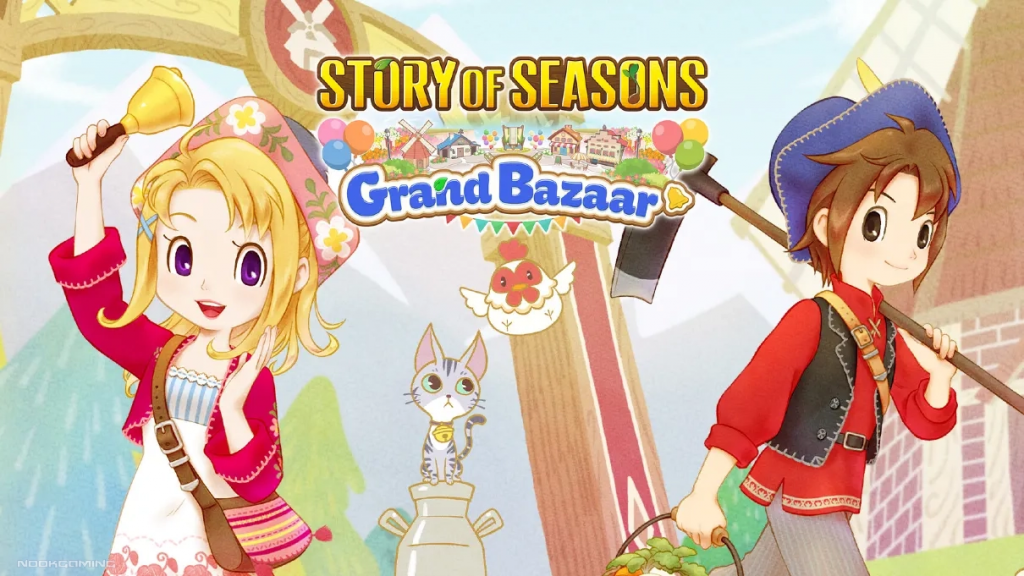
1. Story of Seasons: Grand Bazaar
I have played nearly 100 hours of this game so far. I preface with that because I initially planned to make this the #2 on the list. But, simply for what this game is and how much time I put into it alone this year – it has to be number 1.
I never played the original Harvest Moon: Grand Bazaar (unfortunately). However, with the modernization of the old games under the moniker of “Story of Seasons,” I have picked up every type of remake to-date, so this was no exception. I never expected much, especially when the previous remake was my childhood favorite, Harvest Moon: A Wonderful Life. But when this released and I got my hands on it, I was more than pleasantly surprised.
Many a fan are hailing this as “the best game in the series” and at this point, I am inclined to agree. It is by far the best looking we have seen from Story of Seasons to this point, and what was a small DS title in the series has been remade into a full-sized package worth every penny. One of the first things I noticed that instantly told me this was a quality product was there is a beefy amount of voice acting – something that has been extremely rare for the series outside of some vocal stims and grunts.
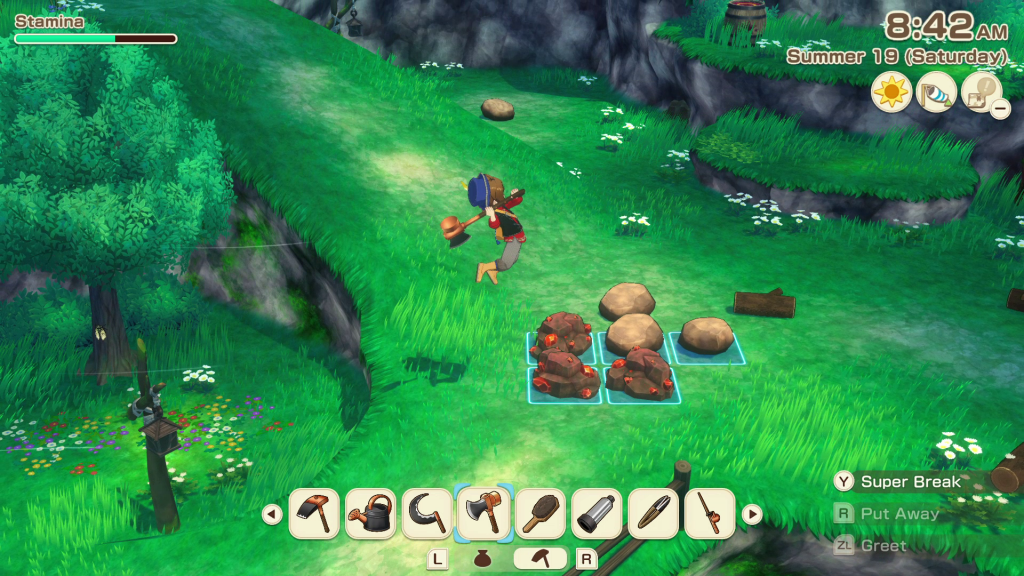
The next thing was that this game looks so pretty. Yes – it’s not revolutionary graphical prowess you would see with a triple A title, but for a long-time fan, this is the same feeling as shifting from a PS3 game to a PS5 game. Colors are deep and lush, the foliage amount and animations really make you “feel” the wind of Zephyr Town. It’s just a cute little treat for your eyes.
Gameplay is solid as ever too (with some caveats). While there is a lack of world customization the baseline titles attempt to give, it is not necessary here. You can unlock more fields, repair the windmills to unlock more resources – there are progression systems, and it all culminates with the overhead system of progressing your bazaar rank. This is an extremely fun loop to work through, as you never feel the need to “skip a day” in any week in the game, as you always need to work on meeting the goals for the next bazaar rank. I do dislike the decay/quality system, as it makes you rush to try and use your produce and food items at all times, and I feel like I am spending half of my harvest on making more seeds than I am simply making money. But those are tiny complaints.
This is one of my top-played games on the Switch 2 or Switch library in general, and is by far the most time I have put into a Story of Seasons game since I was a kid (I lost hundreds of hours of sleep to the original HM: A Wonderful Life). With that being said, these are just some of the reasons I picked this as my stand-out game from 2025.
Honorable Mentions
There were a good amount of games in 2025 that I picked up, but these are mostly ones I picked up near the end of the year and/or haven’t finished enough of to feel like I could place it comfortably on a list like this.
Expedition 33
I waited for the physical release which was pushed back into November, so I didn’t get to start this title until mid-November of 2025. I have yet to finish it and have just started Act 2. I see why people were all about this, but because I did not finish it in time and from some personal opinions on it, I think this is simply a solid RPG to recommend but not quite one to take home all the gold.
Megabonk
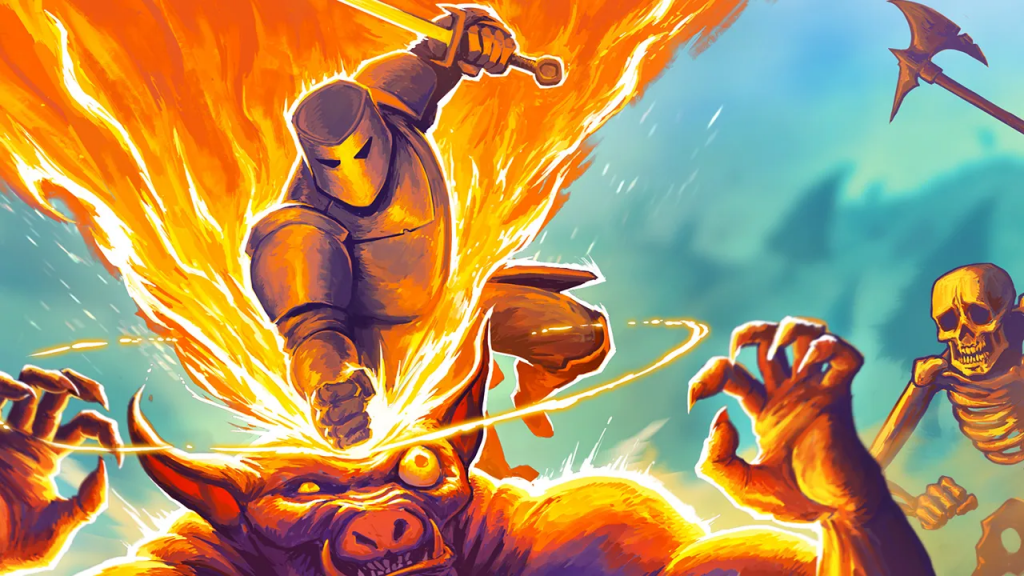
I heard a lot of good things about this throughout 2025, and before I bought it on-sale in late December, I wrote it off as “just another Vampire Survivors” game. To be fair, I do like the gameplay loop of those games, but I really only played Holocure in that genre and nothing else. I decided to pick up Megabonk and man, it is just good fun where you can sort of shut your brain off, but put in enough thought per run to feel like a smart fella. I haven’t played enough and have only unlocked a quarter of the items, but yes, this is a really fun game!
Yakuza 0 Director’s Cut
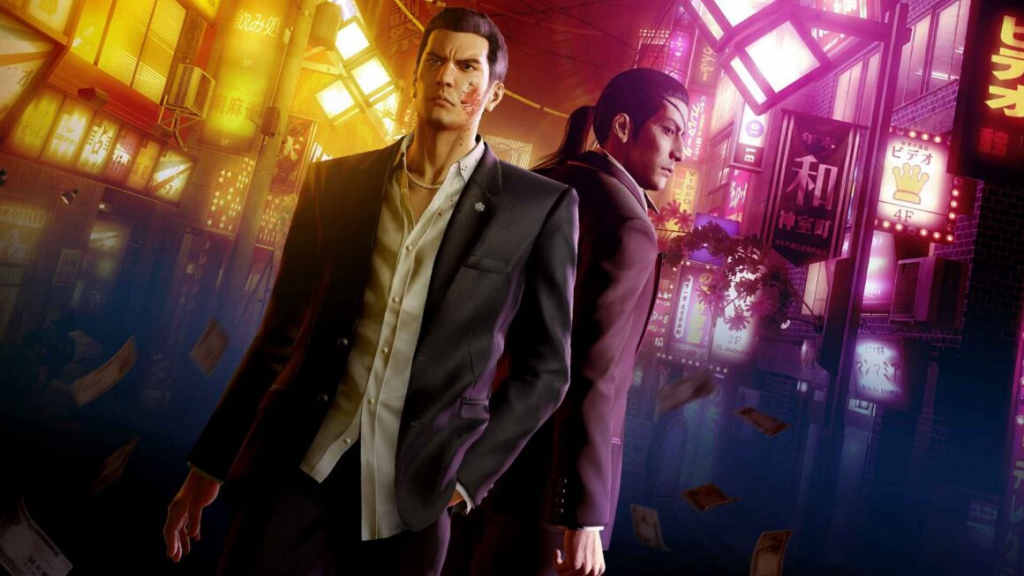
I picked this up a day after the Switch 2 dropped for the simple fact that I had not played Yakuza 0 since back in 2017. Yakuza 0 was my first experience with the franchise, so at the time the appeal of the substories and minigames had not dawned on me, so I remember burning through the game really fast.
As of writing, I have put in over 50 hours into Director’s Cut so far on my Switch 2, and I am glad I picked it up simply because it is letting me truly love Yakuza 0 all over again and to go back and appreciate everything I had neglected before.